A backyard lawn forgives a bad bounce. An artificial turf soccer field doesn't — ball roll, traction, and footing have to be right every match, every season. Spec a soccer surface like a generic backyard project and you get flat spots, a slow roll, and a field that chews up studs by year two.
Here's what actually separates a soccer-ready turf system from a generic sports-turf install: pile height and yarn type for true ball roll, infill that holds traction without punishing slide tackles, seaming and line marking that won't fail first, and the maintenance schedule a high-traffic field actually needs. Whether you're building a full 11v11 pitch, a 7-a-side community field, or scaling the same principles down to a backyard training strip, these are the specs that matter.
Why Soccer Turf Specs Are Different From a Backyard Lawn
A decorative lawn sits there and looks good. A soccer field takes constant sprinting, cutting, and slide tackles across the same few square yards, match after match. That's a different engineering problem, and the industry treats it like one — FIFA runs two certification tiers, FIFA Quality for community and amateur pitches and FIFA Quality Pro for professional-level play, both built on lab and in-situ testing of ball roll, vertical rebound, shock absorption, and seam strength.
You don't need FIFA certification to build a good field. But those benchmarks tell you what "right" actually means: a ball roll in the 4–8 meter range, vertical rebound between 0.6–1.0 meters, and shock absorption around 60–70%. Hit those numbers and the field plays consistent. Miss them and you'll feel it in the first five minutes — a ball that dies on contact, or a surface so hard it beats up knees and ankles.
Pile Height and Yarn Type for True Ball Roll
Pile height is the first spec to get right, and it changes with field size:
- Full-size 11v11: 50–60mm monofilament polyethylene. Taller pile holds infill better and gives the shock absorption a full-size game needs.
- 7-a-side: 40–50mm. A faster game on a smaller surface — shorter pile keeps pace up without sacrificing control.
- 5-a-side / futsal: 30–50mm, often with little or no infill. These small-sided games prioritize speed and close control over cushioning.
Yarn type matters as much as length. Monofilament polyethylene is the standard for soccer — it holds its shape, gives a natural ball roll, and resists the matting that slit-film (fibrillated) turf develops under heavy foot traffic. Slit-film is cheaper and denser, which works for community pitches on a budget, but it wears a visible track down the center of the field faster than monofilament does. Texturized yarn — short, curled fibers — shows up on small-sided and futsal surfaces because it stabilizes infill and improves grip in tight spaces, not because it's built for 11v11 pace.
Shorter pile means a faster game. Taller pile means better shock absorption. Match the spec to the game you're actually building for, not the cheapest roll on the lot.
Infill Choices That Affect Traction and Slide Tackles
Infill does the real work on a soccer field: it holds the yarn upright, controls how the ball rolls, and determines whether a slide tackle ends in a clean stop or a burn.
Most soccer builds use a sand ballast layer topped with a performance infill — crumb rubber, TPE (thermoplastic elastomer), or cork, sometimes blended. Infill depth typically sits 10–15mm below the tips of the fibers:
- Too little infill exposes more yarn than it should, and that extra friction turns a slide tackle into turf burn.
- Too much infill buries the yarn, slows the ball down, and adds weight that makes the surface feel dead underfoot.
Crumb rubber is still the most common infill because it's affordable and performs well, but TPE and cork have gained ground because they run cooler in direct sun and carry less odor over time — both real complaints on crumb rubber fields that bake all summer. Whatever you choose, pair it with a shock pad (commonly 10–25mm) underneath the carpet. The shock pad does the heavy lifting on impact absorption so you're not relying on infill depth alone to keep the surface safe.
Seaming and Line Marking — Where Fields Fail First
A soccer field puts more lateral stress on seams than almost any other turf application — players plant, pivot, and sprint across seam lines constantly, not just walk over them. Two things determine whether a seam holds:
- Pile direction match. Every panel needs its yarn running the same direction. A mismatched seam is visible immediately and wears unevenly from day one.
- Overlap and bond quality. Glued seams need full, even adhesive coverage with proper overlap — skimping here is the single most common cause of a seam that lifts under play.
Line marking is the other failure point. You've got two options: painted lines, which fade under traffic and need refreshing every season or two, or inlaid lines — turf sewn directly into the panel in the home color. Inlaid costs more upfront but it doesn't wear off, doesn't need repainting, and holds up to the exact kind of abrasive, repetitive contact a soccer field's boundary and penalty lines take. For anything getting regular game use, inlaid is worth the extra cost.
The Maintenance Schedule a High-Traffic Field Actually Needs
This is where most fields lose their edge — not from bad installation, but from skipped maintenance. A high-traffic soccer surface needs a real schedule, not an occasional pass with a leaf blower:
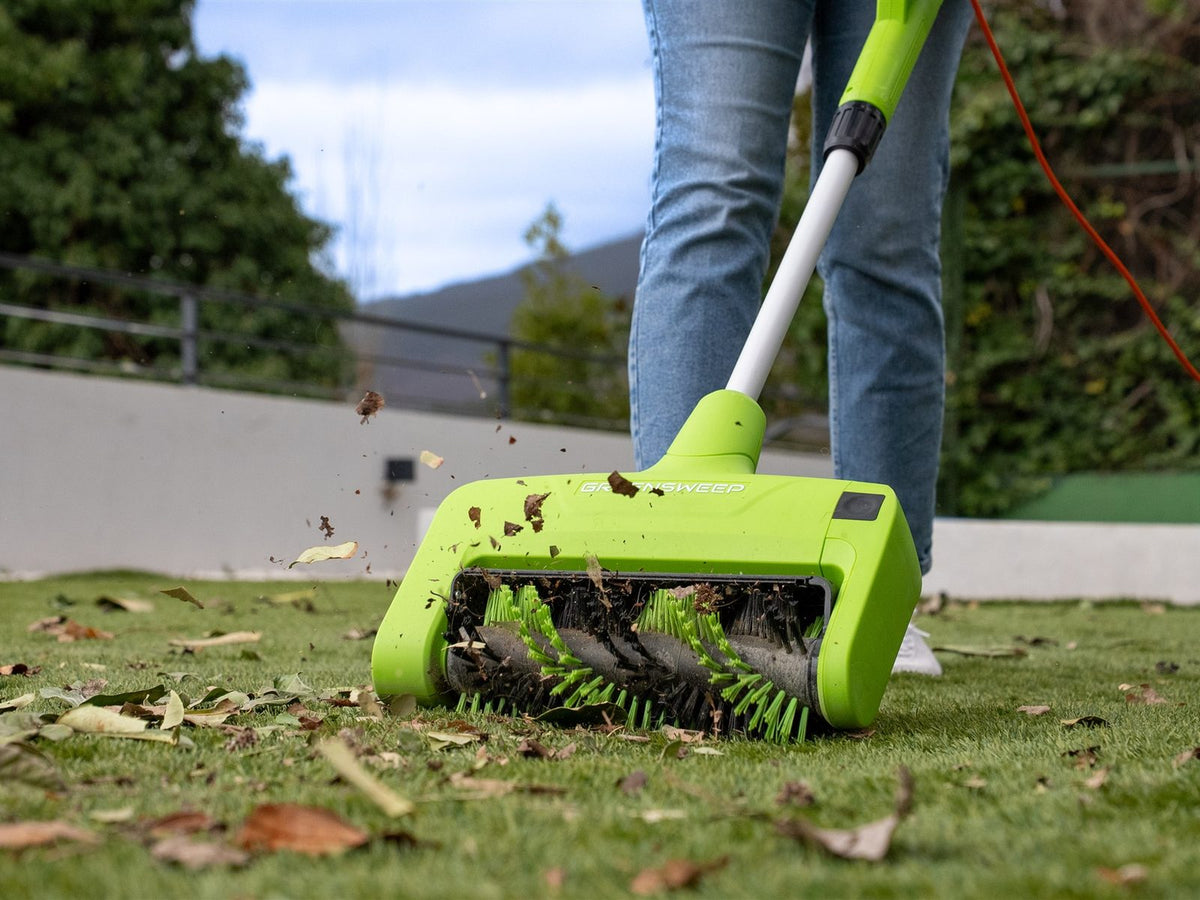
- Grooming / power brushing — stands the yarn back up and redistributes infill that match play pushes into clumps and ruts. Fields seeing heavy weekly use need this weekly; lighter community or training pitches can stretch to biweekly.
- Deep cleaning — clears organic buildup (grass clippings tracked in, cleat debris, general grime) that causes odor and, left long enough, bacterial growth in the infill layer.
- Infill top-ups — infill migrates and compacts under repeated impact. Check depth seasonally and top up before it drops below spec.
- Gmax testing — tracks surface hardness over time. Rising Gmax numbers mean the shock pad and infill are compacting and the field is getting harder — and more dangerous — than when it was installed.
Equipment matters here. A full-size field benefits from something with real grooming power — the Pro Series runs a Briggs & Stratton CR950 208cc engine built for landscaper- and facility-scale grooming, pulling infill back into place and standing fibers up across a full pitch without stalling out. For touch-up work between full grooming passes — sideline wear patterns, goal-mouth compaction — the TurfoVolt gives you 2,500 RPM cordless, so you're not dragging a cord across an active field or waiting on an outlet near the touchline.
Backyard and Training-Ground Builds — Scaling Pro Specs Down
Not every soccer surface is a full pitch. A backyard training strip or a home practice net follows the same principles at a smaller scale, just with lower stakes:
- Pile height can run shorter than a full 11v11 build — you're working on first touch and close control, not full-speed ball roll over 100 yards.
- Infill needs are lighter. Less traffic means less compaction, and a thinner infill layer is easier to maintain yourself.
- Inlaid lines usually aren't worth it for personal training space — painted markings or none at all are fine when you're not hosting matches.
What doesn't change is the brushing habit. A backyard strip still mats down under repeated dribbling and shooting drills in the same spots. Run the TurfoVolt over it every couple of weeks to keep the fibers upright and the ball rolling true — the same grooming principle that keeps a professional pitch playing right, just sized down to your yard.
The Bottom Line
Soccer turf isn't a backyard lawn with lines painted on it. Get the pile height and yarn type right for the game you're building, choose infill that holds traction without punishing contact, seam and mark the field so it doesn't fail where players actually move, and put a real maintenance schedule behind it. Skip any of that and you'll feel it in how the ball rolls and how the surface holds up under a season of real play.
Check the full GreenSweep Guides library for more turf-specific maintenance routines, and gear up with the Pro Series or TurfoVolt to keep your field playing like it did on day one.