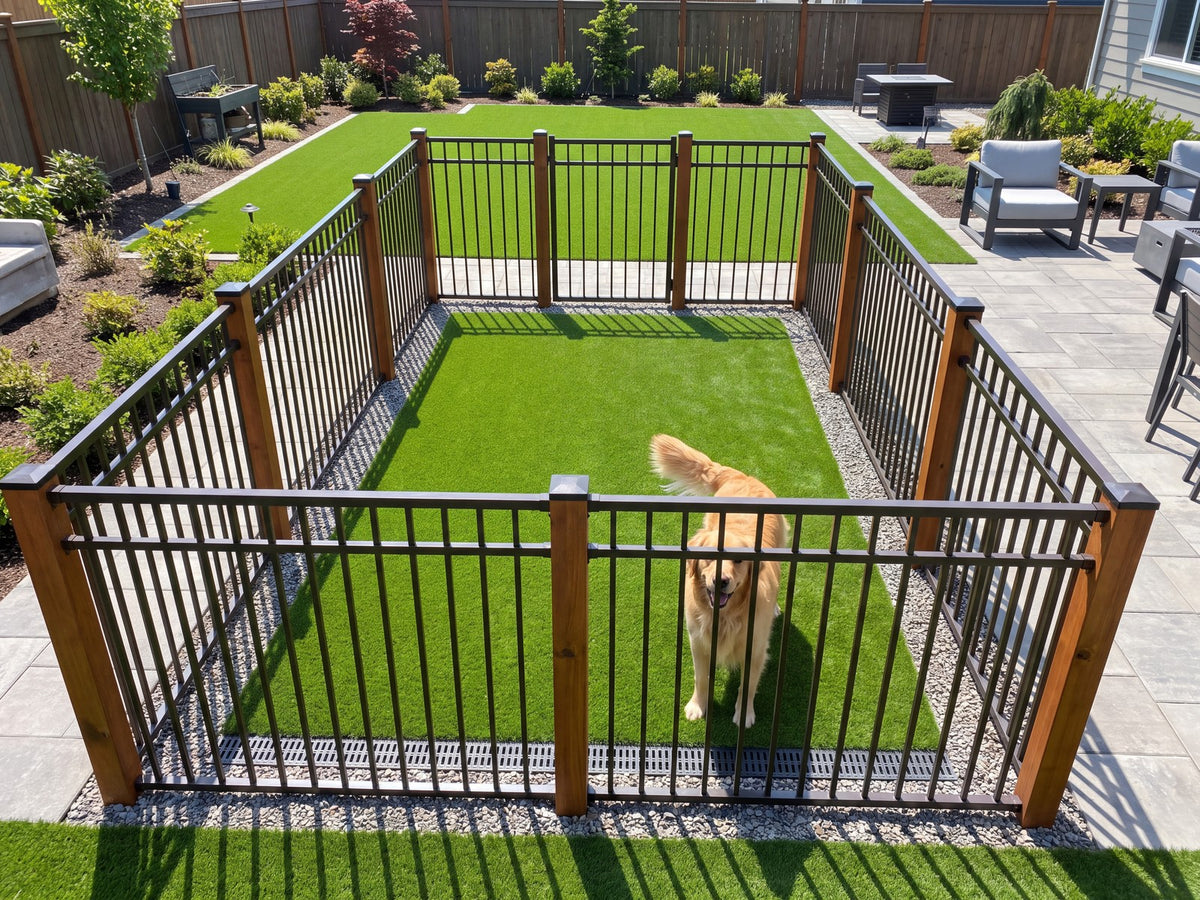
An artificial turf driveway looks great in every photo — clean green lines running up to the garage, no mud, no mowing, no dead patches from where you always park. But a driveway isn't a lawn. It takes tire weight, oil drips, and the same compaction point every single day. Get the base, drainage, or backing wrong and you're looking at ruts, standing water, and flattened pile before the first year is out. Here's what the install actually needs to survive a car.
Why Driveway Turf Needs a Different Spec Than Lawn Turf
Standard residential turf is engineered for foot traffic — people walking, kids playing, a dog running laps. That's distributed, random-direction pressure spread across a soft base built mostly for drainage and comfort underfoot.
A car is a different load entirely. You're putting 1,500+ pounds through four contact points, repeatedly, in the same spots, every time you pull in. That's concentrated, repetitive compression — the kind that pushes a lawn-grade base into the subsoil and crushes fiber in the exact same direction every day until it stops springing back.
There's also a drainage wrinkle most people don't expect: a 2021 study in Urban Forestry & Urban Greening found artificial lawns actually shed more surface runoff than living grass, not less. Turf isn't the sponge real grass is. Add a compacted vehicle-rated base underneath, and water management becomes something you have to design for — not something the turf handles on its own.
Bottom line: a driveway installation needs a denser base, a tougher backing, and a shorter pile than the turf covering your backyard. Treat it like lawn turf and you're rebuilding it in two years.
Base Depth and Compaction for Vehicle Load
This is where most driveway turf jobs fail — not the grass itself, what's under it.
- Lawn turf standard: 3 to 4 inches of compacted aggregate base. Most manufacturer installation guides set this as the baseline, and some turf codes set a 3-inch minimum.
- Vehicle/driveway standard: 4 to 6 inches minimum, and 6 to 8 inches if the driveway sees daily parking or a heavier vehicle. Use a dense crushed aggregate road base — the same class of material used under paver driveways, not a decorative base mix.
Compact that base in 2-inch lifts with a plate compactor, not one deep pour tamped down once. Each lift needs to be wetted and compacted before the next goes down, or you'll get hidden voids that collapse under tire weight six months later. Lay a geotextile fabric between the subgrade and the base — it stops the aggregate from migrating into the soil below, which matters even more on clay-heavy lots where the ground shifts seasonally.
If your installer skips the lift-by-lift compaction step to save a day of labor, that's the corner that turns into a pothole under your tire track.
Drainage: Handling Rain, Oil Drips, and Runoff
Because turf sheds more water off the surface than it absorbs, your base and backing need to do the drainage work the grass isn't doing.
- Slope the base at a 1 to 2 percent grade, directing water away from the foundation and toward a drain, swale, or crushed-stone edge — never toward the house.
- Use a perforated backing, not a solid-backed roll. Vehicle-rated turf should let water pass straight through to the base rather than pooling on the surface where tires sit.
- Plan for fluids, not just rain. Oil drips, coolant, and brake dust sit on top of synthetic fiber instead of soaking into soil the way they would on a lawn. A quick rinse won't fully clear them — you need a degreaser routine, and a base that drains fast enough that standing fluid doesn't sit and stain.
Skipping drainage planning is the single biggest reason driveway turf installs end up with a soggy low corner or a permanent oil halo by the garage.
Backing and Pile Height That Survive Tire Traffic
Pile height and backing weight make or break how driveway turf looks after month three.
- Keep pile height under 1 inch. Taller, lawn-style pile looks lush on day one but mats flat under tire weight and struggles to recover between parking sessions. Short, dense pile holds its shape far better.
- Go denser, not longer. A higher face weight and tighter stitch rate resist compression better than a lighter, bouncier lawn product — you want fiber density working for you, not length.
- Confirm the backing is rated for vehicle traffic, not just foot traffic. Cheap residential rolls use lighter-gauge, less UV-stabilized backing that stretches and sags under repeated point load. A driveway-rated backing holds its shape and its perforation pattern under weight.
Even the right spec will flatten some under tire pressure — that's physics, not a defect. The difference between turf that looks fine in year three and turf that looks trampled is whether you're actively brushing the fibers back upright, which is where your equipment matters as much as the install. Running a TurfoMax power brush over driveway turf weekly lifts crushed fiber back into shape before it sets permanently flat — something hand-raking can't do consistently on a surface that gets compressed daily.
Design Options: Full Coverage, Strips, and Paver Borders
You don't have to put the entire vehicle load on turf. Three common layouts, from most turf-dependent to least:
- Full coverage. Turf across the whole driveway surface. Best look, but every square foot needs the full vehicle-rated base — no shortcuts anywhere tires might land.
- Turf strips between paver or concrete wheel tracks. The pavers carry the actual car weight; turf fills the center strip and edges where tires rarely sit directly. This cuts your vehicle-rated base area roughly in half and is the most common compromise for budget and durability.
- Paver borders with turf edging. Turf sits outside the driving surface entirely — purely decorative framing. Lightest-duty option, and the only one where you can get away with a standard lawn-grade base.
If your installer is quoting a full-coverage driveway at lawn-grade base pricing, that's a red flag — the base work is the expensive part for good reason.
Keeping Driveway Turf Clean Under Regular Car Use
Once it's installed to spec, the maintenance routine is what keeps it looking like day one instead of year one:
- Brush weekly, against the direction of tire travel. This is the single most important habit — it's what reverses the daily compression before it becomes permanent matting. A corded or self-propelled brush like TurfoMax handles this fastest on driveway-sized areas; for larger commercial driveways or shared parking turf, the gas-powered Pro Series covers more ground per pass.
- Treat oil and fluid spots immediately, not on your next cleaning day. A dish-soap-and-water scrub or a turf-safe degreaser lifts fresh drips before they set into the fiber coating — UV-stabilized fiber resists staining far better when you catch it early.
- Rinse monthly to flush brake dust, road grit, and general debris that foot-traffic lawns never accumulate at this rate.
Full maintenance schedules and seasonal routines are covered in our guides if you want the complete upkeep calendar.
The Bottom Line
An artificial turf driveway can absolutely hold up to daily parking and pulling in and out — but only when the base, drainage, and backing are built for vehicle load from the start, not retrofitted from a lawn spec. Go 4 to 6+ inches of properly compacted aggregate, slope for real drainage, choose a short dense pile with vehicle-rated backing, and back it all up with a weekly brushing habit. Skip any one of those and you're paying for the install twice.