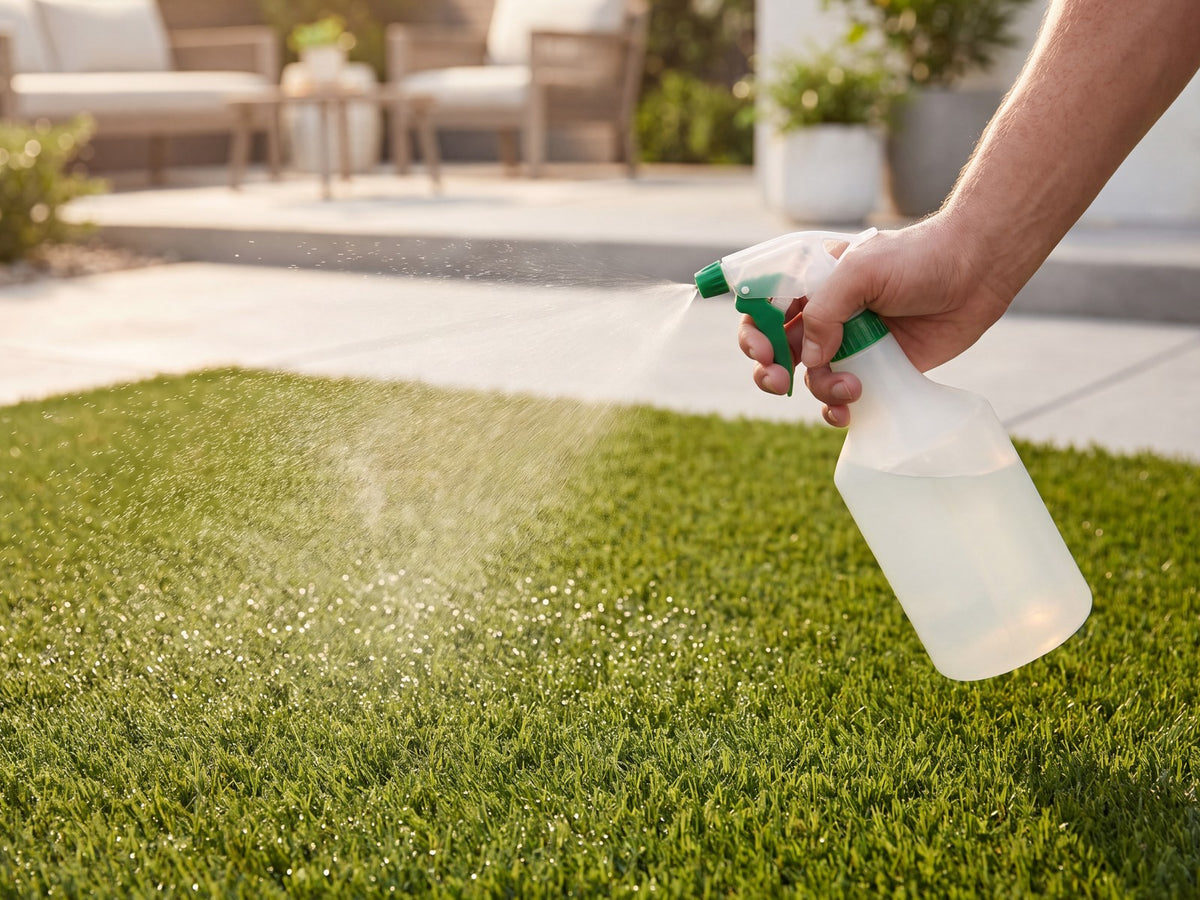
Indoor artificial turf doesn't fade in the sun, doesn't freeze in January, and never gets waterlogged after a storm. That sounds like less work. It isn't — it's different work. Outdoors, rain rinses debris, UV light knocks down bacteria, and open air disperses odor for free. Indoors, none of that happens. Dust sits where it lands, sweat and spills soak into the backing instead of draining away, and a gym, playroom, or home office traps odor instead of carrying it off. If you're running turf in an enclosed space, you need a maintenance plan built for that space — not a watered-down version of an outdoor routine.
Here's what actually changes, and the equipment and schedule that keeps indoor turf clean without turning your room into a dust cloud.
How Indoor Turf Maintenance Differs From Outdoor Turf
Outdoor turf gets three things indoor turf never sees: rain, UV exposure, and constant airflow. Rain flushes loose debris and dilutes surface residue. UV light helps suppress mold and bacterial growth on the fibers and backing. Open-air circulation carries odor away before it builds up.
Take all three away and you're the one doing their job. That means:
- You replace the rinse. Nothing is washing debris out on its own — you have to physically remove it on a schedule, not whenever it looks dirty.
- You replace the sterilization. Without UV knocking back bacteria, sweat and spills can sit and breed odor-causing growth in the backing if you let them.
- You replace the airflow. A closed basement, home gym, or playroom holds onto whatever smell builds up until you either ventilate it or clean it out.
None of this makes indoor turf a bad choice — it just means the maintenance clock runs on your schedule, not the weather's.
Dust, Debris, and Allergens: The Indoor-Specific Problem
Every synthetic turf sheds a small amount of fiber and infill dust over time, especially under foot traffic or equipment. Outdoors, rain washes that dust into the ground. Indoors, it stays airborne or settles back into the pile — which matters a lot in a home gym where someone's breathing hard, or a playroom where a toddler's face is three inches from the surface.
The fix isn't fancier turf. It's getting the dust and debris out of the pile before it has a chance to redistribute itself with every footstep. A quick daily pass with a stiff broom or handheld brush knocks loose debris to the surface where you can sweep or vacuum it. Skip this for a few weeks and you're not dealing with a dirty floor — you're dealing with a floor that kicks up dust every time it's used.
If anyone in the house deals with allergies, this step isn't optional. Dust and pet hair trapped in turf fibers is a bigger problem in a sealed room than it ever is outside.
Building a Cleaning Routine Without Rain to Rely On
Since nothing is rinsing the surface for you, your routine needs to do three things rain normally handles: lift debris, flush residue, and dry fast.
Daily: A quick brush or vacuum pass to pull up loose dust, hair, and fiber debris before it packs down into the pile.
Weekly: A deeper brush with a power broom to stand the fibers back up and redistribute infill that's shifted under foot traffic. Matted fibers trap more dirt and hold odor longer, so this step matters more indoors than outdoors — there's no rain event forcing a reset.
Monthly: A damp clean with an enzymatic turf cleaner, not a scented spray. Enzymatic formulas break down the organic matter causing odor instead of just masking it, which is the only approach that works in a room with no drainage and no sun to help evaporate residue. Work it into the pile, let it sit per the product's instructions, then blot or extract — don't flood the backing.
Our Reviver handles the weekly brush step well in a home gym: corded, 1,300 RPM, 12" width, variable speed so you can dial it back on padded or foam-backed indoor turf without being too aggressive on the backing.
Why Noise and Battery Power Matter for Indoor Equipment
Outdoor maintenance happens in a backyard where nobody's trying to hold a conversation ten feet away. Indoor maintenance happens in a home gym while someone's mid-set, a playroom next to a nap schedule, or an office during work hours. Equipment choice changes because of it.
Cord management is the first practical headache. A corded power broom in a converted garage gym or basement means routing a cord around equipment, outlets that may not be where you need them, and a trip hazard on a surface you're trying to make safer, not less safe. That's where cordless gear earns its keep: our TurfoVolt runs on two G-Core 4Ah batteries for up to 40 minutes at 2,500 RPM — enough to brush a full home gym or playroom without hunting for an outlet or working around a cord.
Weight and maneuverability matter more indoors too. You're working around a squat rack, a changing table, or office furniture, not open lawn — a lighter, cordless unit turns and repositions faster in a tight footprint than a corded machine you're dragging a cable behind.
Odor Control in Enclosed Spaces: Home Gyms, Playrooms, Offices
Sweat, pet accidents, spilled drinks, even just body heat and humidity — in an enclosed room, these compound instead of dissipating. A home gym without a window cracked can hold the smell of a hard session for days if the turf underneath isn't addressed.
The fix is the same enzymatic approach from the monthly clean, applied faster when you know the cause: treat spills and sweat spots as soon as you notice them, not at the next scheduled deep clean. Masking sprays cover the smell for an hour and let the actual cause — bacteria breaking down organic residue — keep working underneath. Enzymatic cleaner breaks down what's actually causing the odor.
After any wet treatment, brush the fibers back upright. Matted turf traps moisture against the backing, and moisture sitting in an unventilated room is exactly the environment that breeds the smell you're trying to get rid of. If you can crack a window or run a fan for an hour after cleaning, do it — it's the fastest way to replace the airflow outdoor turf gets for free.
A Weekly and Monthly Maintenance Schedule for Indoor Turf
Here's the routine that keeps indoor turf clean without becoming a chore:
| Frequency | Task | Why it matters indoors |
|---|---|---|
| Daily | Quick brush or vacuum pass | Removes loose dust/hair before it packs into the pile — no rain to do it for you |
| Weekly | Deep brush with a power broom (Reviver or TurfoVolt) | Re-fluffs matted fibers and redistributes infill before it compacts |
| Monthly | Enzymatic deep clean + spot treatment | Breaks down odor-causing residue rain would normally dilute and wash away |
| Quarterly | Check seams, infill levels, and backing for moisture buildup | Catches compaction or trapped moisture before it turns into odor or wear |
Stick to this and indoor turf stays as low-effort as its reputation promises. Skip it, and you're dealing with matted fibers, trapped odor, and dust buildup that no amount of outdoor-style neglect would ever let you get away with.
The Bottom Line
Indoor artificial turf trades weather damage for a maintenance routine you have to run yourself — there's no rain, no UV, and no open air doing any of the work for you. Build the daily-to-quarterly habit above, pick cordless equipment if you're working around gym gear or furniture, and treat odor at the source instead of masking it. Browse our full lineup of turf maintenance equipment or check the Guides page for more room-specific maintenance routines.