Artificial Grass Drainage: Why It Fails and How to Fix It
Artificial grass drainage is supposed to be a non-issue — that's half the pitch of going synthetic. So when water starts pooling on your lawn after a storm, or your turf stays damp and starts smelling two days later, something's broken. Good news: it's rarely the turf itself. Most drainage failures trace back to one of a handful of fixable causes, and a lot of them have nothing to do with your original installation.
Here's how drainage is supposed to work, what actually goes wrong, and — since this is the part every installer's blog skips — how routine maintenance either protects your drainage or quietly destroys it.
How Artificial Grass Drainage Actually Works
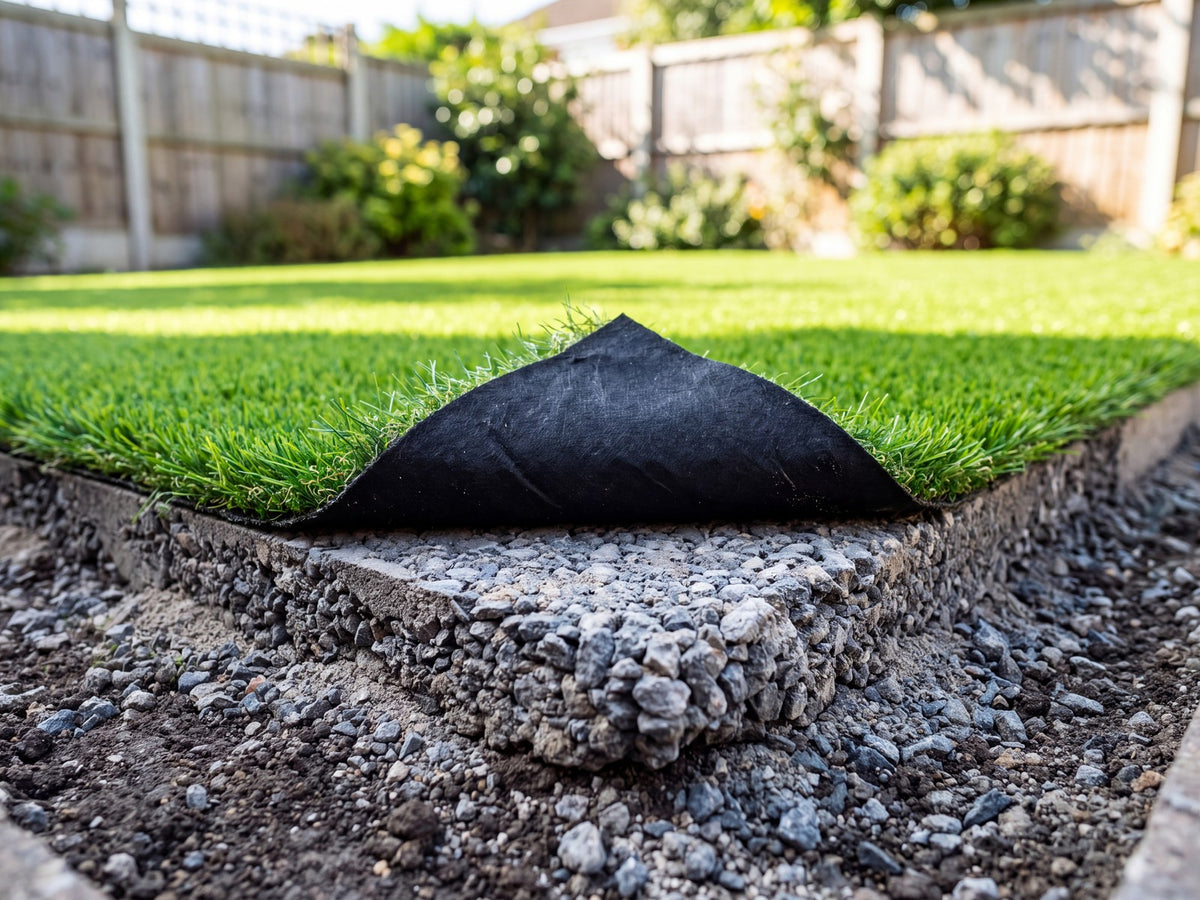
Water moving through a turf system passes through four layers, in order: the grass fibers, the infill, the backing, and the base underneath. Each layer has one job. Miss it, and the whole system backs up.
- Fibers and infill: Water drops through the blades and filters down through the sand or infill packed at the base of the fibers.
- Backing: Most residential turf uses hole-punched backing, which drains around 30 inches of water per hour through small perforations. Premium flow-through backing drains 400+ inches per hour because the entire surface is permeable, not just pinholes.
- Base: A compacted layer of crushed stone or decomposed granite (typically 3-4 inches deep) sits below the backing. It has to be dense enough to stay stable but open enough to let water percolate through and away.
- Grade: A 1-2% slope across the yard directs water toward a drain point instead of letting it sit.
When all four layers are doing their job, a healthy lawn clears standing water within 15-30 minutes of moderate rain. If it's still wet an hour later, one of these layers isn't performing.
Infill choice matters here too, and it's often overlooked. Silica sand is the most common and cheapest option, but it packs down hardest over time. Rubber infill stays looser longer but can trap odor in pet areas. Zeolite and antimicrobial-coated infills cost more but resist compaction and moisture retention better, which means less frequent maintenance to keep drainage at full rate. If you're re-topping infill anyway, it's worth upgrading rather than replacing sand with more sand.
Five Signs Your Drainage Has a Problem
Watch for these, especially after heavy rain or irrigation:
- Standing puddles that don't clear within 30 minutes
- A spongy or squishy feel underfoot in specific spots
- Persistent musty or sour odor that gets worse when the turf is wet
- Visible moss, algae, or dark discoloration in low-traffic corners
- Water pooling at the same one or two spots every time it rains
One symptom on its own might be nothing. Two or more together usually means the drainage path is partially blocked somewhere between the surface and the base.
The Cause Most Installers Won't Mention: Compacted Infill
Every drainage guide online talks about base prep, backing type, and slope — all installation-time decisions. What almost none of them cover: if your turf was installed correctly and is still pooling water two or three years later, the problem usually isn't the base. It's the infill sitting on top of it.
Infill compacts over time from foot traffic, pet use, and weather. As it packs down, it stops acting like a filter and starts acting like a plug — blocking the exact perforations the backing needs to move water through. Add in trapped debris, pet waste residue, and dust, and you've got a surface that looks fine but drains at a fraction of its original rate. This is a maintenance failure, not a construction failure, and it's the one homeowners can actually fix themselves without tearing anything up.
The fix is mechanical: you need to lift and redistribute the infill and clear the debris sitting on top of the backing, restoring the open channels the water is supposed to use. A stiff rake works in a pinch. A power sweeper does it properly and in a fraction of the time. The TurfoMax runs a 13-amp motor through a DuoHelix brush at a 15-inch width specifically to lift compacted infill and pull loose debris up and off the surface — the same mechanical action that unclogs a backing's drainage holes. For yards without a nearby outlet, the TurfoVolt does the same job cordless, running at 2,500 RPM for up to 40 minutes on two G-Core batteries — enough to cover most residential lawns in one charge.
When It Actually Is an Installation Problem
Maintenance won't fix everything, and pretending otherwise wastes your time. If you're seeing any of the following, the issue is below the backing and a power sweeper won't touch it:
- Water pooling in the same low spot regardless of maintenance — this is a grading problem. The base doesn't have enough slope to move water toward a drain point.
- A soft, sinking feel that's spreading, not just one small area — this usually means the base material has too many fines (dust, sand) mixed in, or was under-compacted at install, and it's saturating instead of draining.
- Heavy clay soil underneath that won't accept water no matter what's on top — no amount of surface maintenance moves water through soil that can't absorb it. This needs a French drain or additional subsurface drainage.
These are base and grading issues, and they need excavation, not equipment. If your maintenance routine isn't restoring drainage after two cleaning cycles, stop guessing and get a professional to check the sub-base before you spend more money on surface fixes.
The Maintenance Routine That Actually Protects Drainage
For turf that's installed correctly, here's what keeps drainage working instead of degrading:
- Brush or sweep every 2-3 weeks (weekly for pet-heavy or high-traffic yards) to redistribute infill before it compacts into a solid layer.
- Rinse after pet use to keep waste from breaking down into the infill and clogging perforations.
- Deep-clean twice a year — spring and fall — to clear built-up debris, pollen, and organic matter the routine brushing misses. The Reviver's 1,300 RPM corded motor and variable speed control make it a solid pick for this deeper pass without over-stressing the fibers.
- Check for low spots after major storms. If a new puddle shows up somewhere it didn't before, it's worth investigating before it becomes a permanent problem.
- Keep an eye on infill depth. If it's visibly thinning or unevenly distributed, top it up — bare backing with no infill buffer drains unevenly and wears faster.
Stick to that schedule and you're not just keeping the lawn looking sharp — you're actively preventing the compaction that causes most post-installation drainage complaints.
Seasonal Drainage Considerations
Drainage performance isn't constant across the year, and treating it that way is how small issues turn into standing water.
- Fall: Leaves and seed pods are the top cause of clogged perforations in autumn. A yard that drained fine all summer can back up within weeks once leaf litter builds up on the surface. Sweep more often during peak drop, not less.
- Winter: In freeze-thaw climates, water that doesn't fully drain before a hard freeze can turn to ice inside the base, expanding pore space and disrupting the compaction that keeps the base stable. Clear standing water before a freeze whenever you can.
- Spring: Pollen and organic debris from spring growth settle into infill fast. This is the single best time for the twice-yearly deep clean — it clears a winter's worth of buildup before summer traffic and rain pick up.
- Summer: Heavier rainfall and higher pet and foot traffic combine to compact infill faster than any other season. If you're only sweeping once a month, summer is when to bump it up to biweekly.
The Bottom Line
Artificial grass drainage isn't a set-it-and-forget-it system, even though that's how it gets marketed. The base, backing, and slope your installer built determine your ceiling. What you do after installation determines whether you actually get there. If your turf is pooling water and it was installed right, the fix is almost always mechanical: lift the infill, clear the debris, restore the channels. Get a sweeper into a regular rotation and you'll rarely deal with standing water at all. Browse the full lineup of turf maintenance equipment to find the right fit for your yard size and routine.