An artificial turf tennis court costs anywhere from $30,000 to $200,000 depending on which guide you read — and that swing exists because most of what's written about it is aimed at country clubs and UK schools, not homeowners building a single backyard court. If you're trying to figure out what this actually takes and costs for a residential setup, here's the real breakdown.
Why Artificial Turf Beats Clay and Hard Courts for a Home Court
Clay courts need daily watering and rolling to stay playable. Hard courts crack, need resurfacing every 8–10 years, and turn into a sheet of standing water after a storm. An artificial turf tennis court skips both headaches: no irrigation schedule, no resurfacing crew, and it drains fast enough that you're back on court minutes after rain stops.
It's also easier on your body. The slight give in synthetic turf absorbs impact better than concrete or acrylic coating, which matters if you're playing several times a week and want your knees to agree with you at 50. And because there's no grass to kill off, no mud season, and no off-months for reseeding, you get year-round play — which is the entire point of building a court in your own yard instead of booking a club slot.
Choosing Turf Type, Pile Height, and Infill for True Ball Bounce
Tennis turf isn't landscaping turf. The ITF rates court surfaces by pace category, and pile height is what moves you between them: shorter pile (around 12mm) plays slower and favors long baseline rallies, while taller pile (up to 20mm) speeds up the bounce and rewards aggressive, net-forward play. Pick the height based on how you actually play, not what looks greenest in a brochure.
Infill matters just as much as fiber. Silica sand infill is the standard for court turf — it weighs the fibers down for a consistent, true bounce and keeps the surface from playing "bouncy" or inconsistent from one end of the court to the other. Skip infill, or let it migrate and thin out unevenly, and your bounce gets unpredictable fast. This is the single most common reason a backyard court feels great for six months and sloppy by year two.
Fiber quality counts too. You want a nylon or nylon-blend fiber built to handle constant lateral sliding and foot traffic without crushing — cheap polyethylene lawn-grade turf will mat down under real match play in a season.
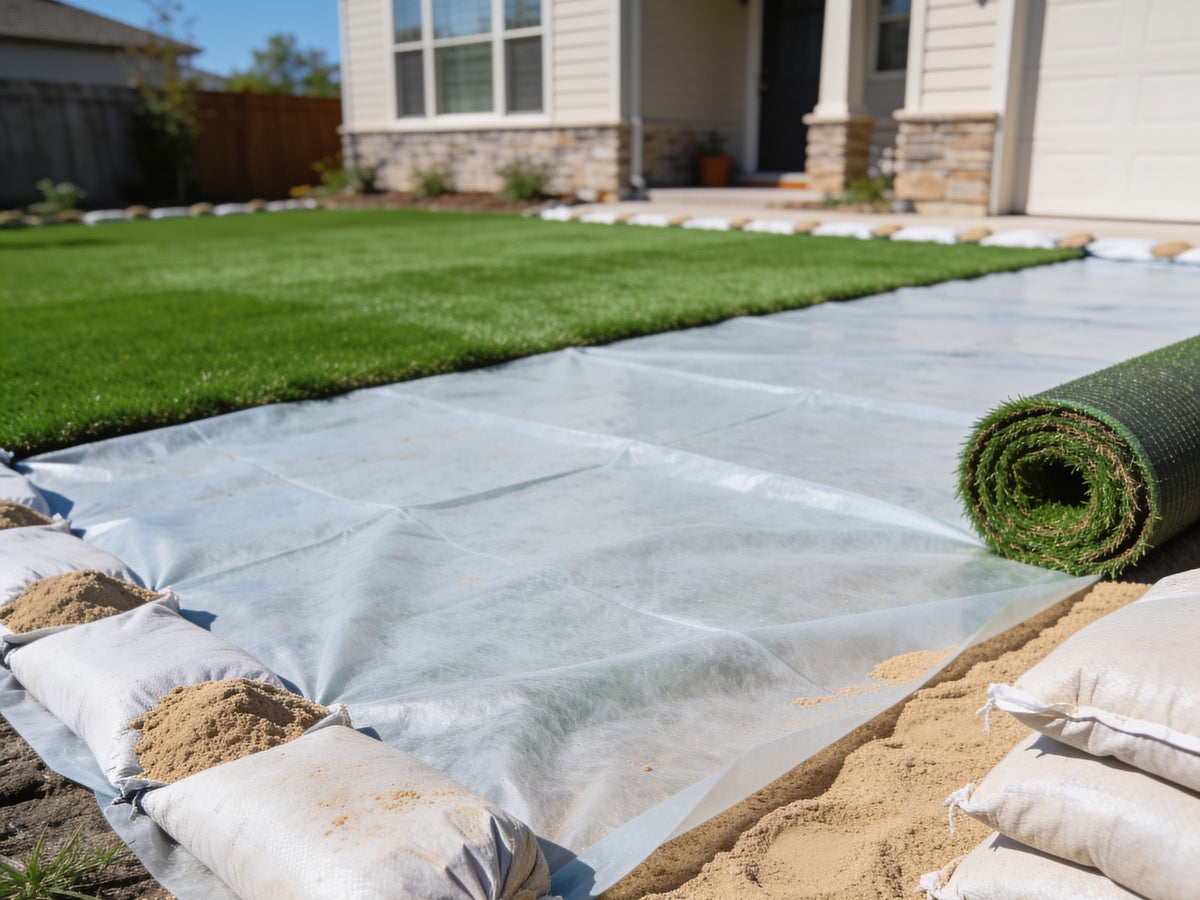
Tennis Court Turf Installation — Base, Lines, and Seaming
This is where a tennis court install diverges hard from a backyard lawn install. A lawn only needs a few inches of compacted base. A court needs an engineered base — typically compacted aggregate with a built-in slope (usually around 1% to 1.5%) so water sheets off instead of pooling at the net. Get this wrong and no amount of turf quality fixes a court that puddles.
Lines are either inlaid (cut into the turf and seamed in with matching-color fiber) or painted on top. Inlaid lines cost more upfront but don't fade, chip, or need repainting — worth it for anything you're not replacing in five years. Seaming matters more here than on any residential lawn job: a seam that sits even a millimeter high will deflect a ball mid-rally, and you'll notice every single time it happens.
Edging and perimeter drainage finish the job — without a clean perimeter drain, water backs up along the fence line and undermines the base from the edges in. Plan for the base work to take longer than the turf install itself — a rushed base is the number one reason courts fail early, long before the turf wears out.
What a Backyard Artificial Turf Tennis Court Actually Costs
Here's the number that matters for a homeowner: a standard doubles court (roughly 60' x 120' including run-off area) typically runs $30,000 to $60,000 for turf, base work, and installation. That's the real residential range. The $100,000+ figures floating around online are almost always commercial or club installs with fencing packages, floodlighting, and clubhouse-grade specs baked in — not what you need for a single home court.
What actually moves your number inside that range:
- Site prep and grading — a sloped or rocky lot costs more to level than a flat yard
- Base depth — deeper, better-compacted base costs more but prevents the puddling and settling that ruins cheap installs
- Pile height and infill choice — a faster, taller-pile turf with deeper infill costs more per square foot than a basic recreational spec
- Fencing and lighting — optional, but they add real money fast if you want night play or ball containment
The upside shows up after installation, not before: annual maintenance on a well-built turf court runs a fraction of what a clay or grass court demands, because you're brushing and topping up infill instead of rolling, watering, and reseeding every season. For context, a clay court demands daily watering and rolling plus a full resurface every 5-8 years, and a hard court needs recoating every 8-10 years at several thousand dollars a pop. A turf court's upkeep is brushing and infill top-ups a few times a year — no resurfacing crew, no seasonal reseeding, no standing water delaying your Saturday match.
Keeping Court Turf Fast and True Under Daily Play
A tennis court takes more concentrated foot traffic than any backyard lawn you'll ever maintain — sliding, pivoting, and sprinting in the same lanes match after match. That compacts infill and lays fibers flat exactly where you need bounce consistency most: the baseline and service boxes.
The fix is regular brushing, not occasional brushing. If you're maintaining your own court, a cordless power sweeper like the TurfoVolt handles this well — two G-Core 4Ah batteries give it a 40-minute run time at 2,500 RPM, enough to groom a full court after a weekend of matches without hunting for an outlet near the baseline. For larger courts or anyone maintaining multiple courts at a facility, the gas-powered Pro Series, built on a Briggs & Stratton CR950 208cc engine, covers more ground per pass and holds up to daily commercial-grade use.
Beyond brushing: check infill depth monthly during heavy-use seasons and top it up before it visibly thins, clear debris before it works into the pile, and treat algae or moss early if your court sits in a shaded corner — it spreads fast on turf that stays damp.
DIY vs. Professional Install — What's Realistic for Homeowners
Be honest about where your skill set ends. Base grading, slope calculation, and seaming are not a weekend DIY project — get the slope wrong by a fraction of a percent and you've built a court that holds water for the next decade. This is the part worth paying a professional installer for, every time.
Where DIY makes sense is everything that happens after the court is built: brushing schedules, infill top-ups, debris removal, and spot treatment. That's routine maintenance any homeowner can handle with the right equipment, and it's exactly the work that keeps a professionally installed court playing like new for 10+ years instead of fading into a slow, uneven mess by year three.
Get the install right once with a pro. Then own the maintenance yourself — check our full lineup of turf maintenance guides for the brushing and infill schedules that keep a court court-ready, match after match.