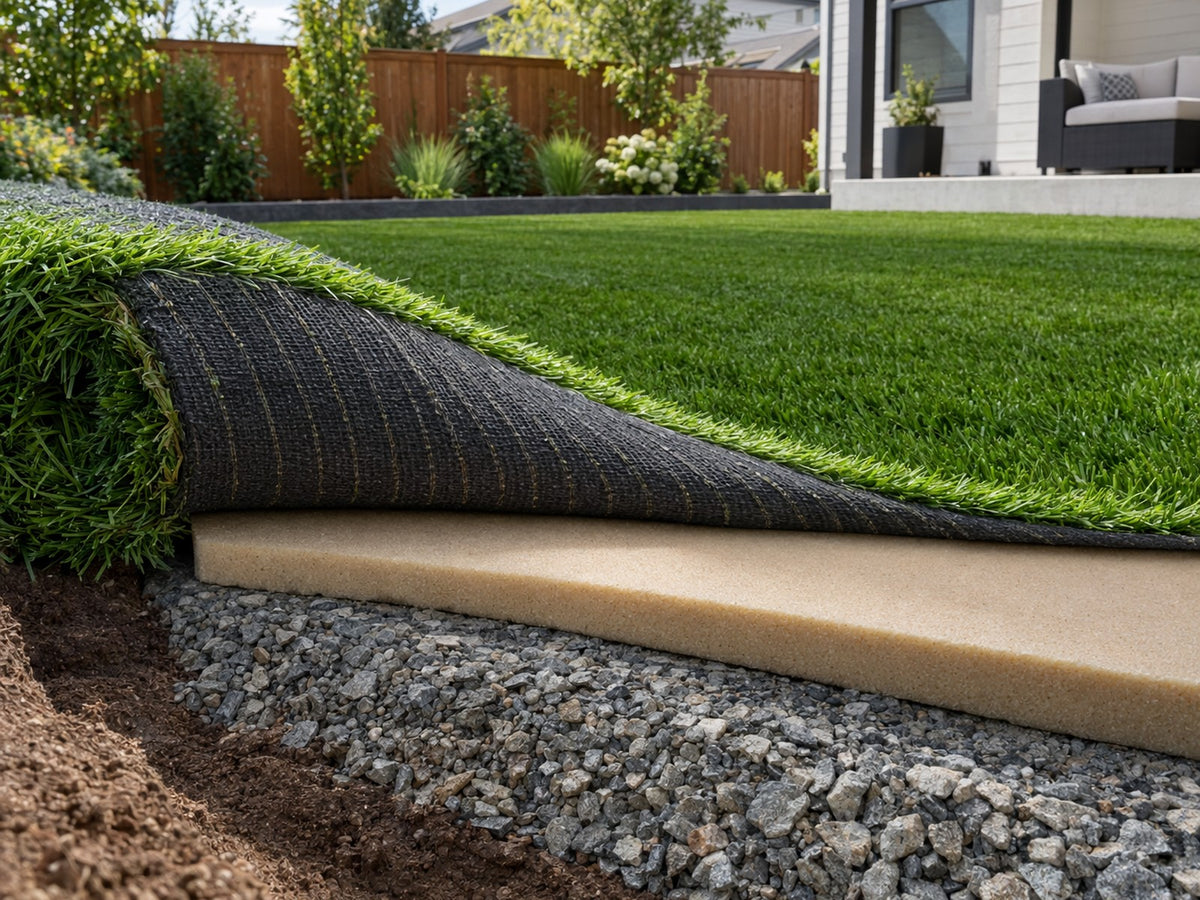
Artificial grass vs. sod comes down to one question most comparison articles dodge: are you optimizing for day-one cost or ten-year cost? Pick wrong and you either overpay for turf you didn't need, or sink years of watering, mowing, and reseeding into a lawn that never quite holds up. Here's the side-by-side that actually answers it — cost, water, durability, climate, and which one wins for pets and high-traffic yards.
Upfront Cost — Artificial Grass vs. Sod
Sod wins the first invoice every time. Installed sod runs roughly $1–$2 per square foot including soil prep and labor, so a 1,000-square-foot lawn lands around $1,000–$2,000. Seed is cheaper still if you're willing to wait months for a usable lawn.
Artificial grass costs more going in — typically $8–$20 per square foot installed, or $8,000–$20,000 for that same 1,000 square feet, depending on base excavation, infill type, and pile height. That gap is real, and it's the number every turf skeptic points to first.
But a single invoice doesn't tell you which lawn actually costs less. It tells you which one costs less today. Everything after move-in day is where the comparison shifts.
Water, Maintenance, and Time Investment Compared
Sod needs water to survive — full stop. A 1,000-square-foot lawn drinks 15,000–24,000+ gallons a year to stay green, more in hot, dry regions with long irrigation seasons. Add 30–40 mowing sessions a year (DIY) or $40–$80 per visit if you hire it out, plus two to four fertilizer and weed treatments, aeration, and overseeding. Total upkeep on a standard residential sod lawn runs $500–$1,500 a year, not counting your own mowing time.
Artificial turf eliminates mowing, watering, and fertilizing entirely — but "zero maintenance" is a myth that gets turf owners in trouble. Fibers mat down under foot traffic and furniture legs. Infill compacts and migrates, which kills drainage and turns a springy surface hard. Debris builds up in the pile and holds moisture and odor against the backing.
The fix is a mechanical brushing routine, not a garden rake dragged across the yard. A power brush like the TurfoMax — 13-amp motor, dual counter-rotating DuoHelix brushes, 15-inch width, self-propelled — lifts matted fibers and redistributes infill evenly in a single pass. Budget 15–20 minutes every two to three weeks for a residential lawn, plus an infill top-off every 2–3 years. That's the whole routine: turf's annual cost sits closer to $50–$200 a year in brushing supplies and occasional rinsing, against sod's $500–$1,500.
Durability and Lifespan — Which Holds Up Longer
Quality artificial turf lasts 15–25 years with that maintenance routine in place. It doesn't go dormant in a drought, doesn't die in a hard freeze, and doesn't get chewed up by grubs or fungus. High-traffic zones — dog runs, play areas, pool decks — hold their shape far longer under repeated abuse than sod ever will.
Sod has no fixed lifespan because it's a living system you're constantly repairing. Drought stress, wear patterns, disease, and pests mean most lawns need patch reseeding every few years, and a full renovation after a decade of hard use isn't unusual. On the flip side, sod can regrow and repair itself where turf fibers can't — damage a patch of grass and it heals; damage turf fibers and you're patching or replacing.
The catch with turf's 15–25-year number: it assumes you actually maintain it. Skip the brushing routine and let infill compact for a couple of years, and you'll see flattened traffic lanes and poor drainage well before the fibers themselves wear out. Material life and actual life are two different numbers if the maintenance gets skipped.
Heat, Drainage, and Climate Considerations
This is the factor most buying guides bury, and it should be near the top. Surface temperatures on artificial turf can run 40–80°F hotter than natural grass on a sunny afternoon — a real issue for bare feet, pets, and anyone in a hot-summer climate. Sod stays cooler because living grass releases moisture through evapotranspiration; it's also better at absorbing stormwater since it doesn't compact the soil underneath the way a turf base system does.
Turf's advantage flips hard in drought-prone regions and anywhere water rates are climbing. No irrigation needed after installation means turf's water savings alone can outweigh the heat tradeoff in places like the Southwest or inland California. In cooler, wetter climates where water is cheap, that math weakens and sod's natural cooling and lower upfront cost carry more weight.
Drainage design matters for both. Sod needs a soil profile and grade that actually moves water away from the house. Turf needs a compacted aggregate base and a real drainage path underneath — a permeable backing alone isn't a drainage plan. Get either installation wrong and you're dealing with standing water regardless of what's on top.
Which Is Better for Pets, Kids, and High-Traffic Yards
For dog runs, play areas, and yards that take a daily beating, turf wins on durability — it doesn't develop the bare dirt patches and mud pits that sod gets under repeated traffic in the same spots. But pet owners need a real cleaning plan: waste removal has to happen promptly, and turf with a polyurethane backing drains and resists odor buildup noticeably better than cheaper latex-backed products. A quick rinse and a regular brush-through with something like the Reviver — corded, 1,300 RPM, 12-inch width, built for smaller yards and patios — keeps odor from setting into the infill.
For families with kids, turf's consistent, debris-free surface and resistance to divots make it the lower-hassle choice for a play area. Sod still wins if the household values a living lawn that cools the yard in summer and doesn't mind reseeding a worn path near the swing set every season.
Shaded yards tip the scale toward turf regardless of pets or kids — grass struggles under trees no matter how much you water and fertilize it, and turf doesn't care about sunlight at all.
The Verdict — How to Choose Between Artificial Grass and Sod
Run your own numbers instead of taking a side in the abstract debate:
- High water costs or drought restrictions where you live? Turf usually wins on 10-year cost.
- Heavy use from kids, dogs, or weekend entertaining? Turf's durability beats sod's wear-and-tear cycle.
- Low water rates and you don't mind weekly upkeep? Sod keeps the lower upfront cost and the natural cooling effect.
- Heavy shade or a slope that won't grow grass well? Turf sidesteps the growing problem entirely.
- Tight budget right now, flexible later? Sod's lower install price wins today — turf can always come later.
- Peak-summer heat and bare feet matter to your household? Weigh turf's surface-temperature jump seriously before you commit.
Whichever side you land on, don't skip the maintenance question if you go turf. A dialed-in brushing and infill routine is what separates a lawn that still looks new at year ten from one that looks tired at year three — ten minutes with a power brush every couple of weeks beats a full re-infill job every time. For the deeper cost math on turf versus a living lawn over time, see our breakdown on artificial grass vs. real grass.
Walk your yard, note the sun exposure, drainage, and wear zones, and you'll usually know which side of this list you're on before you finish reading it. If turf's the answer, check our care guides and shop the full GreenSweep lineup to keep it looking as good as the day it went in.