Lay down the wrong turf and your bocce court plays like a putting green with a limp — balls veering, stalling, taking bad hops off every seam. Building a backyard bocce court with artificial turf isn't the same job as rolling out a lawn. Bocce demands a different pile height, a different nap direction, and a base that's dead flat down to the quarter-inch. Nail those three and you've got a court that rolls true for a decade. Miss them and you're tearing it up in two seasons.
Here's what actually separates a bocce-ready turf install from a backyard lawn job — and the maintenance routine that keeps it playing fast long after the installer leaves.
Why Bocce Needs Different Turf Specs Than a Lawn
Lawn turf is built to look good standing still. Bocce turf is built to let an 8-to-13-pound ball travel 60 feet in a straight line without catching an edge. Those are different engineering problems.
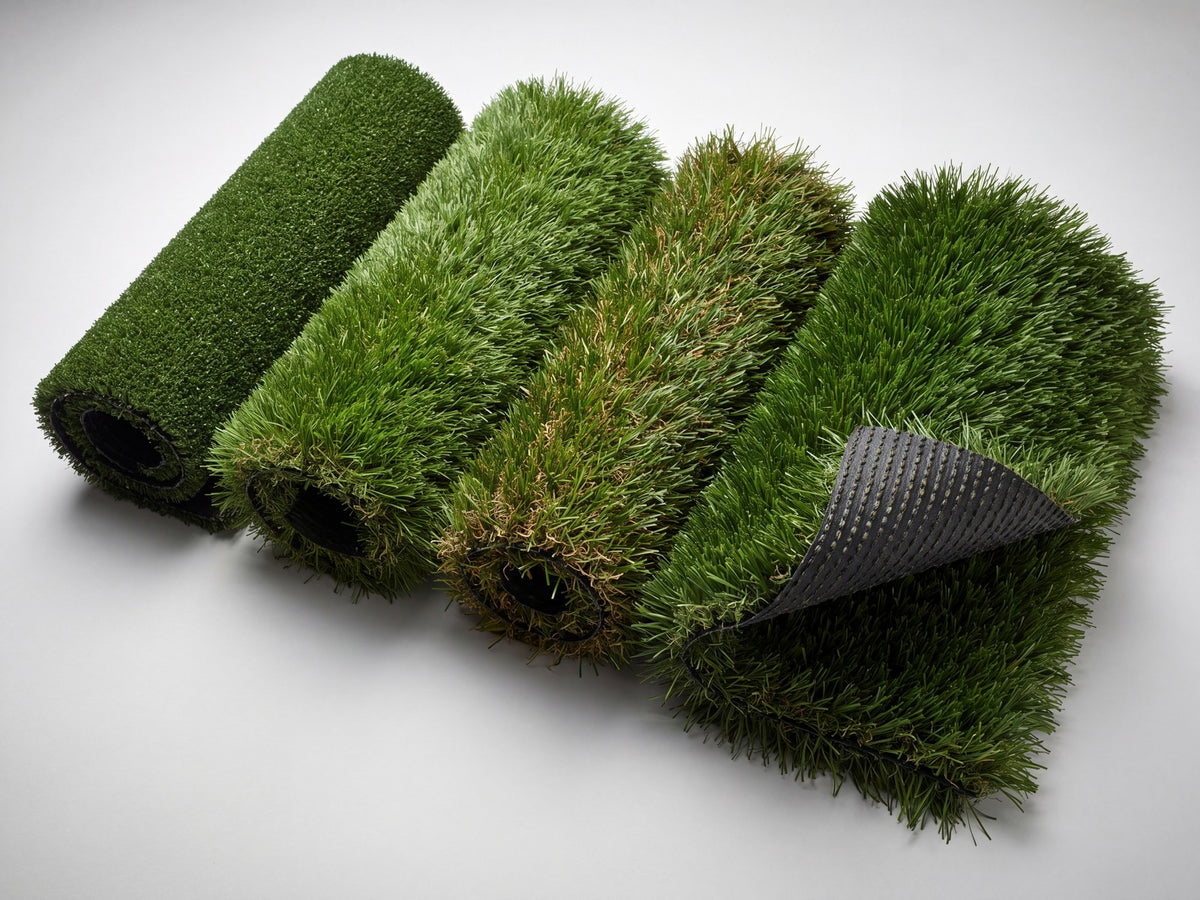
Residential lawn turf runs on polyethylene yarn with a taller pile — 1.5 to 2 inches — designed to look lush and hide seams. That same pile grabs a rolling ball, slows it unevenly, and makes every throw play differently depending on which direction the nap is lying. Dedicated bocce turf uses nylon yarn instead of polyethylene: nylon stands up stiffer, resists matting under repeated rolling impact, and holds its shape through thousands of throws a season. Lawn poly just can't do that — it packs down into tracks within a month of real play.
The other difference is infill. A standard lawn gets a heavy sand or rubber infill to keep the blades upright and add cushioning. A bocce court runs little to no infill, because infill is what slows and skews the roll. Every spec change on a bocce install exists to serve one thing: a ball that travels true, every time, in every lane.
Pile Height and Nap Direction for a True, Consistent Roll
Pile height is the single biggest lever on roll speed. Dedicated bocce turf products run 9/16" to 7/8" pile — roughly a third to half the height of a residential lawn product. Lower pile means less fiber for the ball to push through, which means a faster, more predictable roll. Go taller than 7/8" and you'll fight bounce and drag for the life of the court.
Nap direction matters just as much and gets ignored constantly. Every turf roll has a grain — the direction the fibers lean when they're brushed. On a lawn, grain direction is cosmetic. On a bocce court, it's functional: a ball rolling with the nap travels differently than one rolling against it or across it. If your installer runs multiple rolls across a 60-foot court with the nap pointed different ways, you'll get a ball that curves depending on which half of the court it's in — and no amount of brushing fixes a seam run the wrong direction after installation. Specify nap direction running the full length of the court, in a single pass, before a single roll gets cut.
Base and Border: Keeping a 60' x 12' Court Dead Flat
Official bocce courts run 60 to 91 feet long and 10 to 13 feet wide; most backyard builds land at 40 to 60 feet by 8 to 10 feet to fit the space available. Whatever size you build, the base underneath has to be flatter than anything you'd prep for a lawn.
A compacted decomposed granite or crushed aggregate base, screeded and tamped to a consistent grade, is the standard. Concrete works too, and gives you the flattest possible surface, but costs more and removes any pitch for drainage. If you go aggregate, keep the slope to roughly 1% — enough to shed water, not enough to put a lean on the roll. Anything beyond that and balls will drift toward the low side on every throw.
Borders aren't optional. A bocce court needs a hard edge — pressure-treated timber, bender board, or poured concrete curbing — to keep balls in play and lock the turf's edges from creeping or lifting over time. Skip the border and you'll be re-stretching turf edges within a year, and every out-of-bounds ball becomes a hunt through the yard.
Infill Choices That Affect Ball Speed
Most dedicated bocce turf runs with no infill, or a very light sand infill if the manufacturer calls for ballast to hold the backing down. Compare that to a residential lawn, which typically wants 1 to 2 pounds of infill per square foot for cushioning and blade support.
If your installer defaults to lawn-level infill out of habit, your court will play slow and inconsistent — infill shifts under rolling impact in a way it never does under foot traffic, building up in some lanes and thinning in others over a season. Confirm the infill spec with whatever turf product you're installing rather than letting a general landscaper apply their standard lawn playbook to a sport surface.
Drainage is the other reason infill choice matters. A perforated backing paired with a well-graded aggregate base handles rain without infill washing out or pooling under the surface. Get the backing and base right, and infill stays where it's supposed to.
The Maintenance Routine That Keeps the Roll Consistent Season to Season
This is the part every installer guide skips, and it's the difference between a court that plays true for ten years and one that's drifting and uneven by year three.
After every session: Brush in the direction of the nap to reset fibers that rolling impact has flattened or pushed sideways. A handheld rake like the AstroComb works for quick resets on a backyard-sized court — drag it the full length in one pass, nap direction only, no crosshatching.
Weekly: Clear debris before it works into the pile, and run a deeper grooming pass. This is where a powered brush earns its keep over a hand rake. The Reviver runs variable speed up to 1,300 RPM across a 12" width — enough to lift and realign fibers that have packed down from repeated ball impact without tearing at the stitching the way an aggressive rake can. For courts without a convenient outlet nearby, TurfoVolt covers the same job cordless, with a 40-minute run time that's plenty for a backyard-sized lane.
Monthly: Run a string line down the court to check for low spots — standing water after a rain or a visibly duller patch of fiber both point to a depression forming. Catch it early and you're adding a little base material and re-seating a small turf section. Catch it late and you're patching a divot that's already throwing off every ball that crosses it.
Seasonally: Inspect the border for shift or lift, confirm drainage is still running clear, and do a full deep groom before the heavy-play months start. A court that gets this routine stays consistent; one that doesn't will develop the exact unevenness you spent money on a flat base to avoid.
Cost to Build vs. Hiring an Installer
Turf material alone for a dedicated bocce product runs roughly $3 to $8 per square foot before installation. Add professional installation — base prep, border, and turf laying — and total installed cost typically lands between $12 and $25 per square foot, meaning a 60' x 12' court runs anywhere from $8,600 to $18,000 depending on base material and border choice.
DIY cuts materials and labor costs significantly, but the base prep is where most backyard builds go wrong. Getting a 60-foot run flat and properly compacted takes equipment most homeowners don't own and a tolerance for error most lawn projects don't demand. A reasonable middle ground: hire out the base and border work, where precision actually matters for ball roll, and handle the turf laying and ongoing maintenance yourself. Whatever you spend upfront on getting the base right, you'll spend far less maintaining the court for years afterward — and a lot less than re-leveling a court that was never flat to begin with.
A backyard bocce court built on the right turf spec, a dead-flat base, and a real maintenance routine plays as true in year ten as it did on day one. Get the brushing routine locked in from the start — check out GreenSweep's full lineup of power brushes and groomers built to keep any turf surface, bocce court included, rolling the way it's supposed to.