Ask ten people what the "best" artificial grass is and you'll get ten brand names, zero specs, and no way to actually compare the turf sitting in your cart. Search for it and you'll land on Reddit threads full of guesses. There's no agreed answer because "best" isn't a brand — it's a checklist of numbers most buyers never see.
You don't need to trust a stranger's opinion. You need four specs: pile height and face weight, backing and drainage rate, infill type, and UV stabilization. Check those against your actual use case — pets, kids, high traffic, or a showpiece front yard — and you'll know in five minutes whether a listing is premium turf or a cheap imitation wearing a nice photo.
Pile Height and Face Weight: The Numbers That Actually Matter
Pile height is the length of the grass blade, measured from the backing to the tip. Most residential turf runs 1 to 1.75 inches (25–45mm). Longer isn't automatically better: anything past 1.75" looks lush in a product photo but flattens fast under foot traffic, patio furniture, or a dog's favorite nap spot, and it takes real brushing to keep it standing. For a lawn that gets actual use, 1.5–1.75" is the sweet spot — realistic without being high-maintenance.
Face weight matters more than pile height alone. It's the weight of the yarn per square yard, driven by density (how many fibers per square inch), pile height, and fiber thickness. Residential-grade turf should land at 50+ ounces per square yard of face weight; budget rolls often sit well below that and look thin within a season. Two rolls can have identical pile height and completely different lifespans because one has double the yarn density. If a listing only advertises pile height and skips face weight, that's usually because the number doesn't help their case.
Backing Material and Drainage Rate: Why They Determine Lifespan
Pull back the grass and look at the backing — this is what actually fails first, long before the fibers wear out. There are two layers: a primary backing (woven polypropylene) that the tufts are stitched through, and a secondary backing (polyurethane or latex) that locks those tufts in place and determines tuft bind strength.
PU backing beats latex on nearly every spec that matters outdoors: better tuft bind, more stable in heat and humidity, and it doesn't absorb water the way latex can over time. Latex is cheaper and shows up in budget rolls for a reason. If a product page doesn't say which backing it uses, assume latex and price it accordingly.
Drainage rate is the number everyone skips and shouldn't. Quality backing is perforated with drainage holes every 4–6 inches, and a well-built system should drain well over 30 inches of rainfall per hour. Poor drainage doesn't just mean puddles — it means standing moisture in the infill layer, which is exactly what breeds the bacterial odor that turns into a complaint six months after installation. If you have dogs or live anywhere that gets real rain, drainage rate isn't optional spec-sheet trivia. It's the difference between turf that smells fine in August and turf that doesn't.
Infill Type and How It Changes the Feel Underfoot
Infill is the material brushed down into the fibers after installation, and it does three jobs: it weighs the blades down so they stand upright, it cushions foot traffic, and — depending on the type — it manages odor and heat. Skipping infill or skimping on it is why some lawns look great on install day and matted within a year.
- Silica sand — the standard baseline. Weighs the turf down, inexpensive, does nothing special for odor or heat.
- Zeolite — a mineral infill that actively absorbs ammonia compounds, making it the go-to choice for pet owners. Costs more than plain sand, earns it back the first summer you don't have a urine-smell problem.
- Antimicrobial/coated infill — sand or rubber treated with an antimicrobial coating, aimed at bacterial odor control beyond pet-specific zeolite. Common in commercial and sports installs.
- Crumb rubber — adds cushioning for sports or play surfaces, but it holds heat and isn't the first choice for a residential lawn in a hot climate.
Match infill to your actual problem. A dog owner skipping zeolite to save $0.10 a square foot is the single most common regret in artificial turf reviews — and it's the easiest one to avoid before you buy, not after.
UV Stabilization and Fade Resistance by Climate
Every artificial grass fiber is exposed to the same enemy: UV radiation breaking down the polymer and bleaching the color. UV-stabilized fiber has stabilizers mixed directly into the yarn during manufacturing, not sprayed on afterward, which is the only version that actually holds up.
This matters more in some climates than others. A south-facing yard in Phoenix or Dallas sees far more UV exposure annually than a shaded lot in Seattle, and turf without real UV stabilization in that kind of sun will visibly yellow or fade within two to three years. Ask for the UV warranty length specifically — a serious manufacturer backs the fiber with 10+ years against fading. A listing that's vague about UV protection, or only mentions it in passing, usually means the stabilization is minimal.
Matching Turf Grade to Your Actual Use Case
The "best" turf for a putting green is the wrong turf for a dog run, and both are wrong for a playground. Specs only mean something in context:
- Pets — prioritize drainage rate and zeolite infill over pile height. Shorter pile (1–1.5") also cleans faster and traps less waste.
- Kids and play areas — look for impact-rated backing and padding underneath, plus a mid-range pile that won't abrade skin on a fall.
- High-traffic family yards — face weight and tuft bind strength matter most here. This is where cheap turf shows wear fastest.
- Putting greens — a different category entirely: very short, dense pile (often under 0.5") with a tight gauge built for ball roll, not foot comfort.
- Showpiece front yards — this is where realism specs (multi-tone fiber, thatch layer, curled blade shape) earn their higher price tag, since the lawn is judged on looks over durability.
If a seller can't tell you which use case their product is built for, that's a sign they're selling one grade of turf for every situation — which means it's mediocre at most of them.
The "Best" Turf Still Needs Maintenance — What to Budget For
Here's what every buying guide leaves out: even premium turf with top-tier specs degrades without upkeep. Debris works down into dense fibers and weighs them flat. Infill compacts and stops cushioning. Foot traffic paths mat down and stop springing back. None of that is a defect — it's physics, and it's exactly what separates turf that still looks new at year eight from turf that looks tired by year two, regardless of what you paid for it.
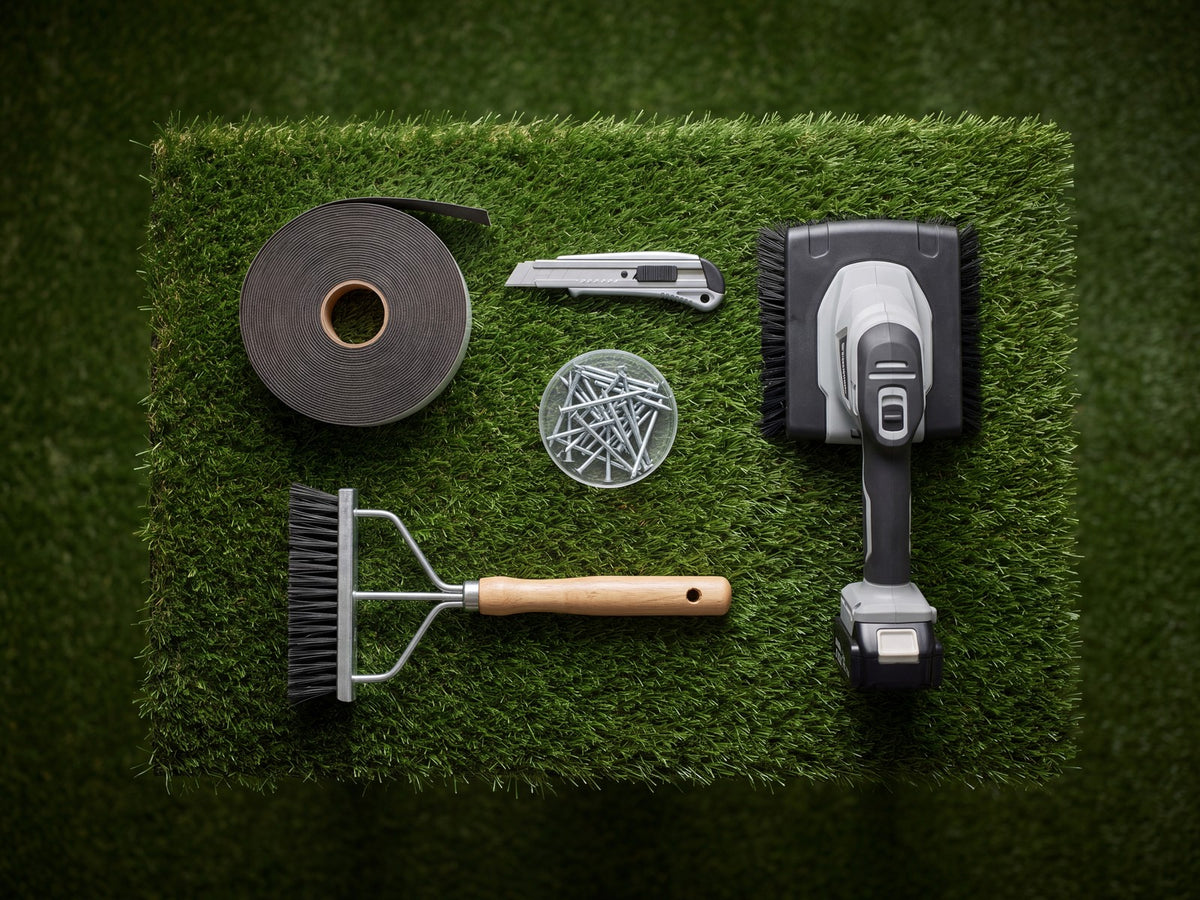
Budget for a brush, not just the install. For small to mid-size lawns, the Reviver — corded, 1,300 RPM, 12-inch width, variable speed — lifts matted fibers and redistributes infill in a single pass, and it's sized right for a weekly 10-minute routine. For larger properties or denser, higher face-weight turf that needs more torque to agitate, the TurfoMax runs a 13-amp motor with a DuoHelix brush at 15 inches wide, self-propelled, built for the kind of pile that fights back against hand-brushing.
A simple baseline: brush high-traffic zones weekly, do a full-lawn pass monthly, and hose down drainage-heavy areas (pet zones especially) on the same schedule. That's the entire maintenance cost of premium turf, and it's a fraction of what a bad spec decision costs you in year three when the "bargain" roll needs replacing.
The Bottom Line
"Best artificial grass" isn't a product you can point to — it's a spec sheet you check before you buy. Pile height and face weight tell you about durability. Backing and drainage rate tell you about lifespan and odor risk. Infill type tells you whether the turf solves your specific problem or just looks good in a listing photo. UV stabilization tells you if it'll still look like grass in five years instead of straw.
Get those four numbers from any seller before you compare price. Then budget for the brush that keeps those numbers paying off. Browse GreenSweep's full lineup of turf maintenance tools built for every grade of artificial grass, or check the Guides page for more spec-driven buying and care breakdowns.