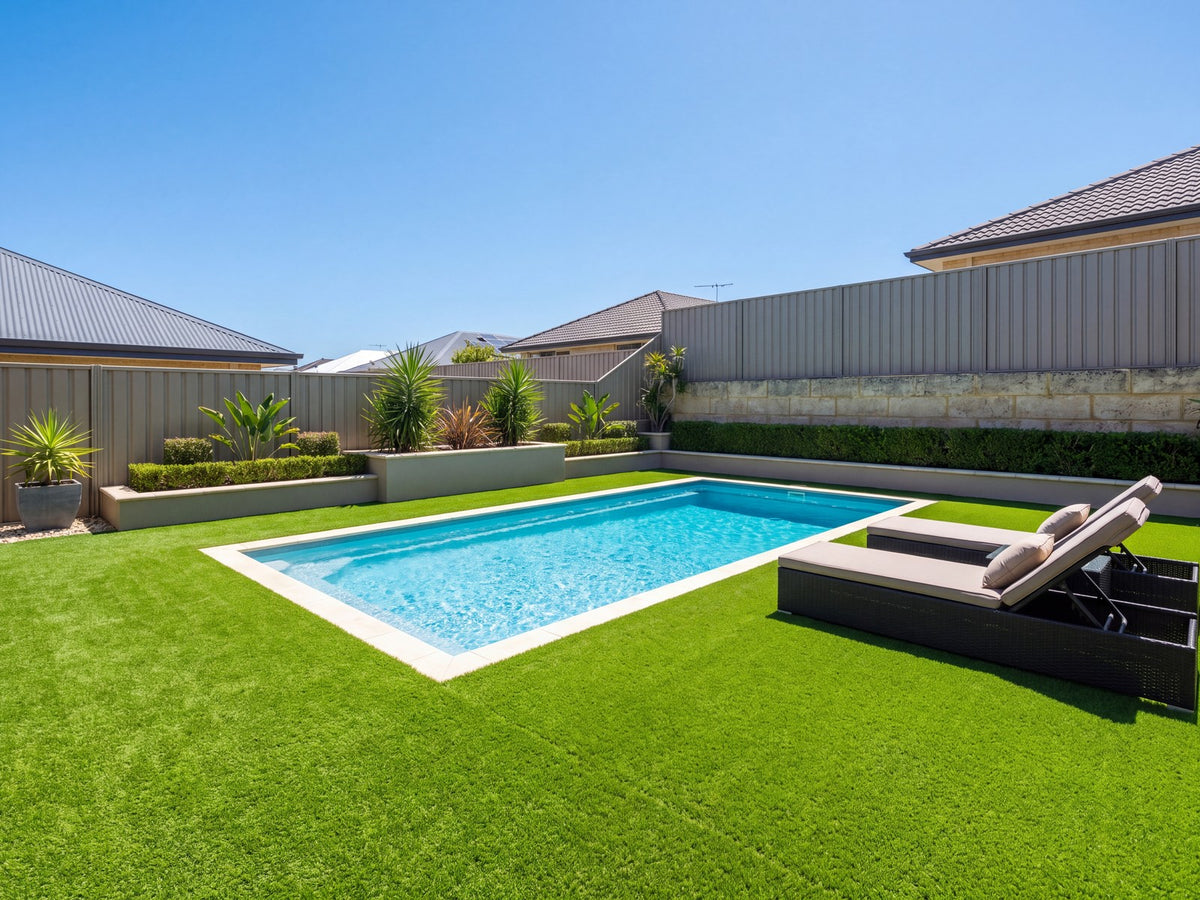
Your artificial grass is wearing out, and the recycling bin on the curb won't take it. That's the blunt truth behind artificial grass recycling: the system most homeowners picture — toss it in with the cans and cardboard, a truck hauls it off, new product comes out the other end — doesn't exist for turf, at least not the way it works for a soda can. Here's what actually happens to old artificial grass, what it costs to get rid of, and the one habit that keeps you out of this problem for years longer than you'd expect.
Why Artificial Grass Can't Go in Your Recycling Bin
Curbside recycling is built for single-material, uncontaminated plastics — a clean PET bottle, a pure HDPE jug. Artificial turf is the opposite of that on purpose: it's a laminate of several materials bonded together so it can survive weather, foot traffic, and UV for a decade.
- The blades are usually polyethylene or polypropylene.
- The backing is latex or polyurethane-coated polyester, glued or stitched to the fiber.
- The infill — sand, crumb rubber, or a coated blend — is packed between the fibers and adds real weight: turf with infill can run 2 to 4+ pounds per square foot, so even a modest 600-square-foot yard can be over a ton once it's rolled up.
Drop that into a single-stream recycling bin and a sorting facility can't do anything with it. It jams equipment, contaminates other recyclables, and gets pulled and landfilled anyway — assuming it doesn't just get rejected at the curb first. Municipal waste programs are blunt about it: Sonoma County's Zero Waste program states plainly that plastic grass "is not recyclable, and must be disposed of in the landfill." That's the rule in most of the country, not the exception.
It's also why watchdog groups have pushed back hard on turf industry recycling claims. Public Employees for Environmental Responsibility filed a formal complaint arguing that marketing synthetic turf as broadly "recyclable" is misleading, since the domestic infrastructure to actually do it barely exists. Treat any blanket "fully recyclable" claim on a product label with some skepticism — ask where, specifically, it gets recycled.
What Happens to Turf That Ends Up in a Landfill
For most homeowners, landfill is still where old turf goes — not because anyone chooses it, but because it's the only option available in their area. And once it's there, it behaves like any other plastic: it breaks down slowly into microplastic fragments rather than decomposing, which is the same concern driving several counties to flag it as an emerging waste problem rather than a solved one.
Scale it up and the math gets uglier. An average full-size synthetic sports field covers roughly 80,000 square feet and holds about 400,000 pounds of infill plus 40,000 pounds of carpet. Landfilling a field that size runs somewhere between $30,000 and $60,000 in tipping fees alone. Your backyard isn't a sports field, but the same cost logic applies at a smaller scale: the heavier the infill, the more it costs to haul and dump, and the less likely a hauler is to offer you a recycling alternative instead of the nearest landfill.
None of this makes turf a worse choice than a water-hungry, chemical-fed lawn over its lifetime — but it does mean the "set it and forget it, it's basically zero-waste" pitch some installers use doesn't hold up once you look at what happens on the back end.
Specialty Turf Recyclers: What They Actually Do With Old Turf
True material recycling — separating fiber, backing, and infill into clean streams and remanufacturing them into new products — does exist, just not at your curb. A handful of facilities process synthetic turf this way, mostly built to handle sports-field volume: turf is shredded, backing and fiber polymers are separated, sand and infill are washed and screened, and the output becomes things like recycled plastic kickboards, benches, and new infill. Industry data on these processes shows the split is roughly 49% sand reused, 45% infill reused or recycled, and about 5% of backing and fiber recycled into new products — meaning the bulk of what gets "recycled" is the easy stuff, while the plastic carpet itself is the hardest piece to recover.
What's actually available to a homeowner usually falls into one of three categories:
- Resale/reuse dealers. Companies that buy and resell used turf sections — not recycling in the technical sense, but it keeps material out of a landfill and gets you a modest resale credit if your old turf is still in decent shape.
- Manufacturer take-back programs. A small number of turf brands run their own take-back pipeline, but only for their own single-polymer product lines, and usually only if you're replacing with the same brand.
- Regional specialty recyclers. A short list of facilities, concentrated near major metro areas, that accept turf for actual material recycling — availability depends entirely on your zip code.
Call before you assume. The honest answer for most homeowners outside a major metro is that recycling isn't on the table, and the choice comes down to landfill, resale, or reuse.
What Removal and Disposal Actually Cost
Professional removal and disposal typically runs $1 to $6 per square foot, depending on your region, access to the yard, and how the infill gets handled. For a typical residential job, that lands most homeowners somewhere in the $1,000 to $5,000 range — a 500-square-foot yard tends to fall around $750 to $3,000, while a 2,000-square-foot lot can push toward $8,000 to $12,000 if drainage work or heavy equipment access is involved.
What's actually in that number:
- Labor — cutting turf into strips, pulling fasteners, and hauling it out, typically 45–60% of the total.
- Disposal/dump fees — $100 to $800, landfill tipping fees if there's no recycling option nearby.
- Equipment and dumpster rental — $150 to $700, especially on larger jobs where a skid steer speeds things up.
Doing it yourself cuts the labor line, but don't underestimate the weight — infill-loaded turf gets heavy fast, and you'll still need a dumpster or a landfill drop-off slot booked ahead of time. Either way, get an itemized quote before you sign anything. Ask specifically whether disposal goes to a landfill or a recycler, and whether infill is being separated — that's the line item that determines whether you're actually diverting any of it from a dump.
Repurposing Old Turf Before You Toss It
If your turf is coming out because you're upgrading — not because it's falling apart — don't haul all of it away. Sound sections have real second lives:
- A dedicated pet run or dog area, away from where appearance matters most.
- Garage or workshop flooring, where a durable, low-maintenance surface beats bare concrete.
- Garden pathways, laid as a weed-suppressing walkway between beds.
- A practice putting green patch, if the pile height and density are right.
- Donation to a school, shelter, or community garden that can use flooring or play-surface material.
One caution: turf that's been a dedicated pet area for years usually carries bacteria and odor residue deep in the backing that doesn't come out with a surface clean. Don't reuse that section somewhere people will sit or kids will play — landfill is the right call there, and it's also the clearest sign that a cleaning routine matters from day one, not just at replacement time.
The Maintenance Habit That Delays Replacement by Years
Here's the part most recycling guides skip: the real lever you have isn't what happens after your turf dies — it's how long you can put that problem off in the first place. Turf that's brushed and groomed regularly hits the upper end of its 8-to-10-year lifespan. Turf that's left to mat, compact, and trap debris fails early, and early failure is exactly what sends perfectly good turf to a landfill years ahead of schedule.
The fix isn't complicated. Regular brushing lifts flattened fibers before they set permanently, and keeps infill distributed instead of compacting into hard, water-shedding patches that accelerate wear. A corded sweeper like the Reviver handles that in a single pass on a standard-size yard — no gym-level elbow grease required, and it's the cheapest insurance policy against an early, expensive removal job.
Pair that with the right maintenance routine for your specific setup — pet areas, pool surrounds, and high-traffic paths all wear differently — and you stretch years of useful life out of turf that would otherwise be heading for the curb. Browse the full lineup in the GreenSweep shop to match a tool to your yard size before matting becomes a replacement decision instead of a maintenance one.
Quick Answers to Common Questions
Can artificial grass be recycled at all?
Technically yes, but only at a small number of specialized facilities that separate fiber, backing, and infill into clean material streams. There's no nationwide curbside or drop-off system for it the way there is for paper or glass, so "recyclable" in theory doesn't mean "recyclable near you."
Is old artificial turf considered hazardous waste?
No — standard residential synthetic turf is treated as regular construction/demolition debris at most landfills, not hazardous waste. It still can't go in a curbside recycling bin, and some haulers charge extra for the weight.
Can I just cut it up and put it in a dumpster rental?
Usually yes, which is why most homeowners doing a DIY removal rent a dumpster rather than bagging it curbside. Cut it into manageable strips first — a rolled 10-by-20-foot section with infill still in it is awkward and heavy to lift whole.
Does keeping turf clean actually extend its life, or is that marketing?
It's not marketing — matted, compacted, debris-packed turf wears out from the inside long before the fibers visibly fail. Regular brushing and infill redistribution is the single biggest lever homeowners have over how many years they get before facing a removal decision at all.
Artificial grass recycling isn't the clean, curbside process most people assume — it's landfill by default, resale or regional recycling if you're lucky enough to have access, and a real cost either way. The one thing fully in your control is how long you can put off that decision. Keep it brushed, keep it clean, and you'll get years more out of the turf you've already got.