Artificial grass around a pool has to survive things a front lawn never sees: constant splash-out, sunscreen residue, chlorine, scorching concrete-adjacent heat, and bare feet walking on it all day. Get the artificial grass around pool spec wrong and you're left with matted turf, a chemical smell baked into the fibers, or a surface that's actually more slippery than the pool deck it replaced. Get it right, and it's the lowest-maintenance, highest-comfort option you can put around water.
Here's what actually matters when you're speccing artificial grass for a pool surround, and the maintenance routine that keeps it performing after the installer leaves.
Why Pool-Area Turf Needs Chlorine- and Heat-Resistant Specs
Not all artificial turf is built the same, and pool surrounds expose every weak point in a cheap product fast.
Standard residential turf is engineered for dry lawns — UV stability and foot traffic, not daily chemical exposure. Put it next to a pool and two things go wrong quickly: the fibers lose color and go brittle under repeated chlorine splash, and the backing — if it's not a pool-rated polyurethane or fully perforated design — starts breaking down from constant moisture.
Look for turf specifically rated for chlorine and saltwater exposure. That means:
- Stabilized, UV-treated fibers that resist chlorine bleaching, not just sun fading.
- Polyurethane or fully-permeable backing instead of standard latex, which degrades faster under wet-dry cycling.
- A face weight in the 50–60 oz range, which holds up to concentrated foot traffic better than lighter residential-grade turf.
This is the one area where cutting corners shows up in six months, not six years. If your installer can't tell you whether the product is chlorine-rated, ask for the spec sheet before you sign anything.
Drainage: Handling Splash-Out and Chemical Runoff
A pool surround sees more water per square foot than any other part of your yard, and drainage is where most installs fail. If water doesn't move through the turf and base fast, you get standing water, mildew smell, and a surface that stays slick long after the splashing stops.
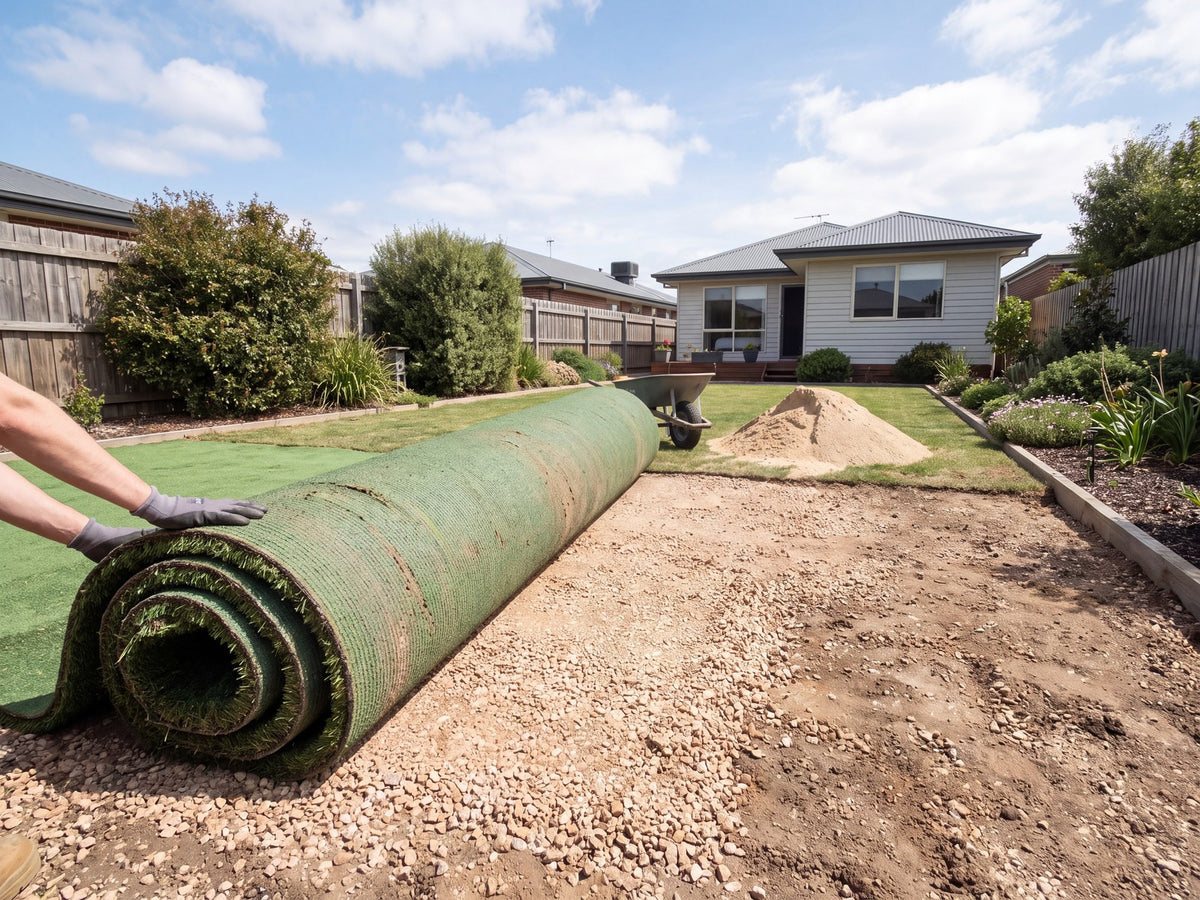
The base matters more here than almost anywhere else:
- Permeable base material — crushed granite or a specialty drainage aggregate — rather than compacted soil, which holds water and breeds odor.
- A slight grade away from the pool (roughly 1–2%) so runoff has somewhere to go instead of pooling at the turf's lowest point.
- A fully perforated backing, not just occasional drainage holes, so chlorinated water passes through instead of sitting on the surface.
If your yard has heavy clay soil underneath, budget for extra base depth and a French drain tie-in. Skipping this step is the single most common reason pool-area turf fails early — not the turf itself, but what's underneath it.
Slip Resistance and Barefoot Comfort Near Water
Nobody wants a pool deck that's more dangerous wet than the concrete it replaced. The good news: well-specced turf is genuinely safer than tile, stone, or stamped concrete when it's wet, but only if you pick the right pile and infill.
For comfort and grip right at the water's edge:
- Shorter pile heights (around 1 inch) grip better underfoot when wet than longer, shaggier styles that flatten and get slick.
- Textured or dual-tone fibers improve traction without feeling rough on bare skin.
- Avoid high-sheen fiber finishes — they look good dry but turn glossy and slippery when soaked.
Turf also runs noticeably cooler underfoot than stone or concrete in direct sun, which matters more around a pool than almost anywhere else in your yard. That's a genuine upgrade over the hardscape most pool decks default to.
Infill Choices That Won't Break Down From Chlorine Exposure
Infill is where a lot of pool-area installs quietly go wrong. Standard silica sand infill can compact and trap chlorine residue and sunscreen oils, which is exactly what causes that chemical smell people associate with bad artificial turf.
Better options for pool surrounds:
- Antimicrobial-treated infill (often branded as odor-resistant or Microban-treated) that resists bacterial buildup from sunscreen, body oils, and chlorine residue.
- Zeolite infill if you also have pets using the same area — it actively absorbs ammonia and odor rather than just sitting inert.
- Avoid crumb rubber infill near pools — it holds heat and can leach a rubber smell when saturated repeatedly with chlorinated water.
Infill isn't a one-time decision either. It compacts and needs topping off, which is exactly where the right equipment earns its keep — more on that below.
The Cleaning Routine for Sunscreen, Chlorine, and Debris Buildup
This is the part most guides skip, and it's the difference between turf that looks new in year three and turf that looks tired by next summer.
Weekly:
- Rinse with a garden hose to flush chlorine residue, sunscreen, and sweat out of the fibers before it bakes in under the sun.
- Brush against the grain with a stiff-bristle broom or a dedicated power brush to lift fibers that get matted down from lounge chairs and foot traffic — the Reviver handles this in one pass without the elbow grease of a hand broom.
Monthly:
- Deep-clean with a mix of water and mild dish soap (never bleach-heavy cleaners — they can react with chlorine residue already in the fibers) to break down sunscreen and oil buildup that a rinse alone won't clear.
- Check infill levels along high-traffic paths — around lounge chairs, the pool ladder, and gate entries — and top off low spots before they turn into bare patches.
Seasonally:
- Run a cordless power brush like the TurfoVolt over the whole surround to redistribute infill evenly and fully restore pile direction after a summer of heavy use — no cord to manage around a wet pool deck is a real advantage here.
- Inspect seams and edges for lifting, which is more common near pools because of constant wet-dry cycling at the perimeter.
Skip the routine entirely and you'll see the two most common pool-turf complaints: a faint chemical odor that never fully airs out, and fibers that stay flattened in the paths people actually walk.
Cost and Install Considerations Specific to Pool Surrounds
Pool-area turf runs higher than a standard lawn install — expect a premium over basic residential turf for the chlorine-rated product, the upgraded permeable base, and the tighter installation tolerances pool decks demand. It's worth it: a poorly specced cheap turf job around a pool fails in one to two seasons, while a properly built one holds up for a decade or more.
A few cost factors specific to this use case:
- Base prep is the biggest line item, especially if existing concrete needs to be removed or clay soil needs extra drainage aggregate.
- Perimeter detailing around curved pool edges, coping stones, and equipment pads adds labor time that a straight lawn install doesn't have.
- Budget for maintenance gear up front. A power brush and the right infill aren't optional extras here — they're what keeps a pool-grade install performing like one. Browse the full lineup in the GreenSweep shop and match the tool to how much surface you're covering.
Artificial grass around a pool isn't a compromise if you spec it right. Get the chlorine-rated turf, the drainage base, the right infill, and a real cleaning routine in place, and it outperforms every hardscape alternative — cooler, safer, and a lot less work than the concrete it replaces.