How Do You Clean Artificial Grass the Right Way?
If you want to know how to clean artificial grass without wasting a Saturday on your knees, the answer comes down to three habits: clear debris weekly, treat stains and odors as they happen, and run a power brush over the whole yard a few times a season. Skip any one of those and your turf goes flat, dingy, and — if you've got pets — starts to smell. Do all three and a synthetic lawn stays showroom-green for 15+ years with a fraction of the effort natural grass demands.
Most guides stop at "hose it down and brush it." That's not wrong, it's just incomplete. A garden hose and a stiff-bristled rake move surface debris. They don't restore blade fibers, break up matted infill, or pull embedded grit out of the base — the stuff that actually shortens a lawn's lifespan. Below is the full routine: what to do weekly, what to do for deep messes, and the one tool upgrade that turns a two-hour chore into a fifteen-minute one.
Weekly Upkeep: Clearing Debris and Loose Dirt
Weekly maintenance is the cheapest insurance you'll ever buy for your turf. Leaves, twigs, pet hair, and dust settle into the fibers fast, and left alone, they compact the infill and choke drainage.
Here's the five-minute weekly pass:
- Blow or rake off loose debris. A leaf blower is fastest; a flexible lawn rake or stiff-bristled push broom works fine for smaller yards. Go with the grain of the blades, not against it — you're clearing debris, not fighting the fibers.
- Rinse with a garden hose. A light rinse knocks down dust and pollen that a rake can't grab. You don't need pressure — just enough flow to move particles through the infill and out the drainage holes.
- Spot-check high-traffic zones. Gates, walkways, and anywhere pets congregate collect grime faster than the rest of the lawn. Give these areas a second pass.
Skip this weekly habit and by month two you're not cleaning anymore — you're excavating. Matted, packed-down turf needs a deep clean and a power brush to recover, which brings us to the harder stuff.
Deep Cleaning: Stains, Odors, and Pet Waste
Weekly upkeep handles dust and leaves. It does nothing for pet urine, spilled food, grease, or the sun-baked grime that builds up over a season. That needs a targeted deep clean.
For pet waste and urine odor:
- Remove solid waste immediately — don't let it sit and bake into the fibers.
- Rinse the affected spot thoroughly. Urine odor comes from ammonia and uric acid crystals that plain water alone won't fully break down, but flushing the area reduces concentration and buys you time.
- Apply an enzyme-based turf cleaner formulated for synthetic grass, not a generic all-purpose spray. Enzymes break down the proteins that cause the smell instead of masking it with fragrance.
- Let it sit per the product's dwell time, then rinse again.
For general stains (food, drink, dirt):
- Mix a mild dish soap with water in a spray bottle or bucket — a few tablespoons per gallon is plenty.
- Apply to the stain, let it sit for a couple of minutes, then agitate gently with a soft brush.
- Rinse thoroughly. Residue left in the fibers attracts more dirt.
For odor across the whole lawn, not just spot areas:
This usually means drainage is compromised — infill has compacted, or debris is blocking the perforations underneath. A hose-and-soap routine won't fix that. You need to physically lift and separate the fibers and disturb the infill layer so it drains again, which no amount of spraying accomplishes on its own.
The Fastest Way to Clean Artificial Grass: Power Brushing
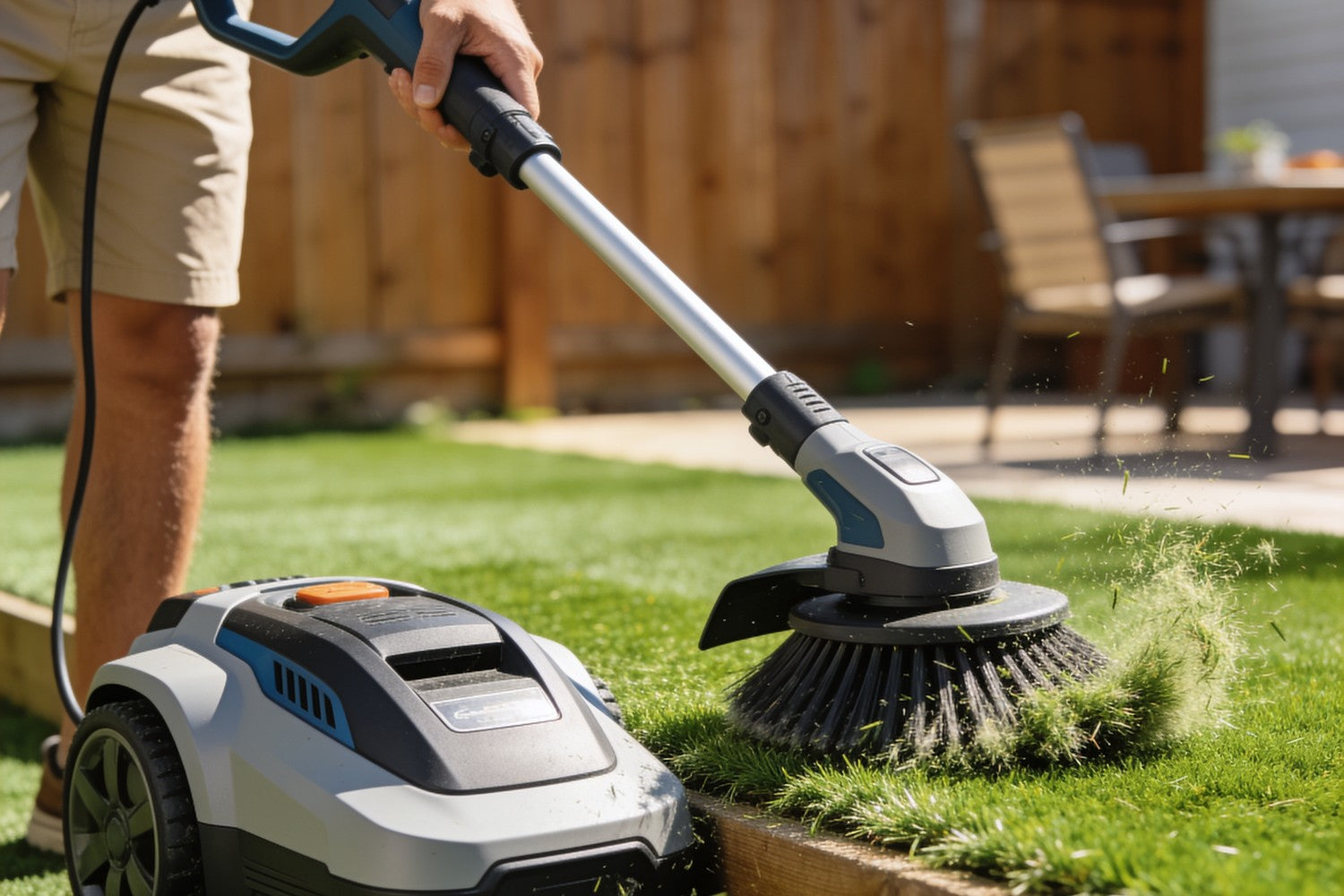
Here's the gap almost every cleaning guide misses: hand tools clean the surface, but they don't restore the turf. A rake or push broom moves debris around. It doesn't lift crushed fibers, redistribute compacted infill, or dig grit out of the base the way a motorized brush does — and that's the difference between turf that looks tired after a year and turf that looks new after five.
A dedicated turf power brush does three things a hand rake can't:
- Lifts flattened fibers back to vertical so the lawn looks full instead of matted.
- Redistributes and loosens infill so water and urine drain through instead of pooling.
- Cuts cleaning time by more than half on an average residential lawn.
This is where the right equipment earns its keep. The TurfoMax runs a 13-amp motor through a DuoHelix brush at a 15-inch (380mm) working width and is self-propelled — you guide it, it does the pushing. For smaller yards, patios, or anywhere weight and maneuverability matter more than coverage, the Reviver is a corded 1,300 RPM unit with a 12-inch width and variable speed, so you can dial down power for infill-light putting greens or crank it up for high-traffic backyard turf.
Run a power brush pass every 4–6 weeks on high-traffic lawns, or seasonally on lower-use turf, and you eliminate the deep-clean marathon most guides describe. Debris lifts out instead of packing in, and pet odor has nowhere to hide because drainage stays open.
Cleaning Products That Damage Synthetic Turf (Avoid These)
Not every cleaner that's safe on a countertop is safe on turf. A few products will quietly wreck yours:
- Bleach and chlorine-based cleaners. They discolor synthetic fibers and break down the latex backing over time.
- Oil-based degreasers. They can dissolve the adhesive holding seams and infill in place.
- Anything with acetone or strong solvents. These melt or warp the polyethylene/polypropylene blades — permanently.
- High-heat pressure washers. A garden hose is fine. A gas-powered pressure washer on a hot setting can literally melt turf fibers or blast infill clean out of the base.
- Metal-tined rakes or wire brushes. These tear fibers and shred backing instead of grooming it. Stick to plastic-tined rakes or a purpose-built power brush.
If a product label doesn't specifically say "safe for artificial turf" or "synthetic grass safe," don't gamble your lawn on it.
A Seasonal Cleaning Schedule That Actually Works
Consistency beats intensity. Here's a schedule that keeps turf looking new without turning into a chore:
| Frequency | Task |
|---|---|
| Weekly | Blow/rake debris, light hose rinse |
| Bi-weekly (pet households) | Enzyme cleaner on waste areas |
| Every 4–6 weeks | Power brush pass to lift fibers and restore drainage |
| Spring | Deep clean after pollen season, check infill levels |
| Summer | Extra rinse cycles in heat, monitor for odor buildup |
| Fall | Increase debris removal frequency as leaves drop |
| Winter | Clear snow with a plastic shovel or broom — never salt or de-icer |
Set a recurring reminder for the power brush pass. It's the step homeowners skip most often, and it's the one that determines whether your turf looks like year one or year ten.
DIY Cleaning vs. Calling a Pro
Most residential turf owners can handle 100% of this routine themselves — weekly debris removal, spot-treating stains, and a seasonal power brush pass are all straightforward with the right tools. Call in a professional turf cleaning service only if:
- You're dealing with a large commercial or sports field installation.
- Odor persists after a proper enzyme treatment and power brushing, which usually points to a drainage or base issue under the turf itself.
- You've inherited turf with unknown history and want a full inspection before committing to a maintenance routine.
For everyone else, the math favors DIY: a power brush pays for itself within a season or two versus recurring service calls, and you control the schedule instead of waiting on a contractor.
Bottom Line
Knowing how to clean artificial grass isn't complicated — it's about consistency. Clear debris weekly, treat stains and pet odor as they happen with turf-safe products, and run a power brush through the lawn every 4–6 weeks to restore drainage and lift fibers. Skip the power brush and you're stuck doing the deep clean the hard way, by hand, every single time. Add it to your routine and most of the work disappears. Browse GreenSweep's full turf care lineup to find the right sweeper for your lawn size and get back to enjoying the yard instead of maintaining it.