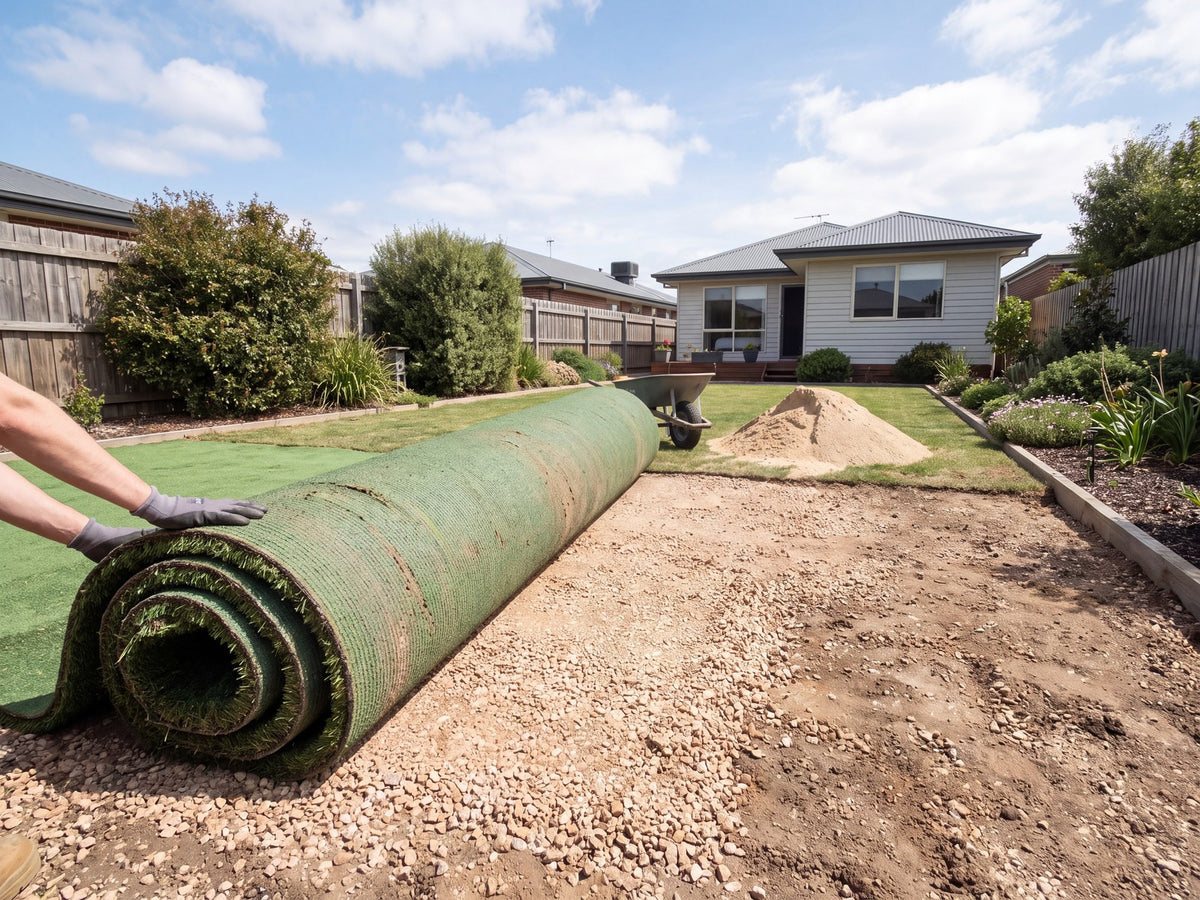
Online artificial grass calculators spit out a number. They don't tell you whether that number is right. Most are built for one scenario: a clean rectangle with no obstacles, standard roll width, and zero waste from odd angles. Your yard probably isn't that. Here's how to measure it so the number you plug into any calculator — or hand to an installer — actually holds up, plus how to size your maintenance gear once the turf's down.
Measuring Irregular Yards Without Overestimating
Start by outlining only the area getting turf — not the whole yard. Beds, patios, and anything staying as-is come out of the outline before you measure, not subtracted from the total afterward. That one habit prevents the most common overestimate.
Break the space into rectangles. A back lawn, a side strip, and a pet run along the fence are three separate measurements, not one combined guess. Keep them separate on paper — you need them apart to plan roll layout and seams, and added together for a total.
For curves, angled beds, or anything that isn't square, measure to the widest point and treat it as a rectangle. Turf comes off rectangular rolls, so a curved bed consumes the full rectangle around it whether the curve uses all of it or not. That offcut is material you've paid for — plan for it instead of getting surprised by it.
Use a 100-ft tape or a laser measure for anything over 30 feet in one direction — a fabric tape sags and stretches, and that error compounds across a whole yard. For reference, satellite measuring tools can rough out a shape in minutes, but always verify the on-the-ground number before you order. Pools, trees, and utility access points don't show up reliably on aerial imagery.
Why You Always Add a Waste and Seam-Overlap Margin
Square footage measured is not square footage purchased. Turf ships in fixed-width rolls — usually 15 feet, sometimes 12 — and you can't buy a partial width. Whatever you cover at an angle, around a curve, or past the last full strip becomes an offcut you paid for but didn't use.
Budget 5 to 10% waste for a simple rectangular yard, and closer to 12 to 15% for a yard broken into multiple zones, curves, or anything with more than four corners. Add a few extra inches of overlap at every seam — turf gets trimmed to a clean cut on installation, and you lose some width in that process. Shorting the seam allowance is how installers end up with a visible gap mid-project and no material left to fix it.
Don't round down to save money here. A yard that's short one roll width mid-install means a rush order, a shipping delay, and a job that sits half-finished on your lawn for a week. Order the margin up front.
Converting Square Footage Into a Realistic Cost Range
Once you have a real, waste-adjusted square footage, multiplying it by a per-square-foot price gets you a budget range, not a quote. Professionally installed artificial turf typically runs somewhere in the $8–$20 per square foot range depending on region, base prep, and product grade — material alone is usually a smaller slice of that than people expect; base work (excavation, grading, drainage, crushed aggregate) often costs as much as the turf itself.
If you're DIYing the install, your number shifts: turf and seam materials, a compactable base aggregate at roughly 3 inches deep plus a 10% overage for compaction loss, infill, and seam tape. Price each separately before you commit to a total — bundling everything into one guess is exactly what makes online calculators unreliable for anything other than a flat rectangle.
Either way, get your waste-adjusted square footage locked first. Every other number in the budget scales off it.
Rolls, Seams, and Why Layout Direction Matters for Ordering
Decide your run direction before you finalize an order, not after. Every piece of turf in a job needs its pile grain running the same way, or the seams read as a visible color and sheen difference in daylight — no amount of brushing fixes a grain mismatch after installation.
Lay your rectangles out along that chosen direction, then calculate strips: divide the width you're covering by the roll width and round up. Each strip needs the run length plus a few inches of trim allowance at both ends. Multiply strips by cut length for total linear footage to order.
Compare both layout directions on paper before you lock in an order. The direction with fewer seams usually wins even if it uses slightly more material — fewer seams means less tape, less adhesive, less install time, and fewer spots where the lawn can show a line down the road.
Here's how that plays out in practice. Say you measure two rectangles: a 20 ft x 30 ft backyard (600 sq ft) and a 4 ft x 25 ft side strip along the fence (100 sq ft) — 700 sq ft measured, kept as two separate numbers for roll planning. Both are simple rectangles, so you apply the lower end of the waste range: 700 sq ft x 1.08 (8% waste) = 756 sq ft to order. On a standard 15-ft roll, the 30-ft backyard run needs two strips (30 ft width ÷ 15 ft roll width = 2 strips) at roughly 31 ft cut length each with trim allowance, or 62 linear feet total. The side strip fits inside a single 15-ft-wide roll with room to spare, so it's one 25-ft cut and no seam at all. That's the math a flat online calculator skips, and it's the difference between ordering 700 sq ft and ending up short with visible gaps, or ordering 756 sq ft and finishing with a clean, fully seamed lawn.
Sizing Your Maintenance Equipment to Your Actual Square Footage
The same square footage number that drives your turf order should drive your equipment purchase. A power brush built for a 300 sq ft side yard is the wrong tool for an 1,800 sq ft backyard, and vice versa — undersized gear means more passes and more time; oversized gear is harder to maneuver in a tight space.
For yards under roughly 500 sq ft, a corded, lighter unit like the Reviver covers the space efficiently — 1,300 RPM, a 12" width, and variable speed control for tighter corners and borders without dragging a cord-reel setup you don't need.
For 500 to 1,500 sq ft — most standard residential lawns — you want more width and power per pass. The TurfoMax runs a 13-amp motor through a 15" DuoHelix brush and self-propels, so you're not pushing dead weight across a mid-size lawn. If you'd rather skip the cord entirely, the TurfoVolt runs two G-Core 4Ah batteries at 2,500 RPM for up to 40 minutes — enough for most residential jobs without a single outlet.
Past 1,500 sq ft, especially on commercial or multi-zone properties, a corded or battery unit starts fighting you on run time and reach. That's the gap the Pro Series closes — a Briggs & Stratton CR950 208cc petrol engine built for landscapers and pro crews covering ground all day, not a single pass on a Saturday.
Quick Reference: Square Footage to Equipment Match-Up
- Under 500 sq ft (patios, side yards, small pet runs): Reviver — corded, 12" width, 1,300 RPM.
- 500–1,500 sq ft (standard residential lawns): TurfoMax (corded, 13-amp, 15" self-propelled) or TurfoVolt (cordless, 40-min runtime, 2,500 RPM).
- 1,500+ sq ft (large residential, HOA common areas, light commercial): Pro Series — 208cc petrol, landscaper-grade.
Measure once, measure in zones, add your waste margin before you order — and buy the brush that matches the lawn you actually have, not the one the calculator assumed. That's the difference between a number that's technically correct and one you can actually build a budget and a maintenance routine around. Check the full lineup on the All Products page before you order.