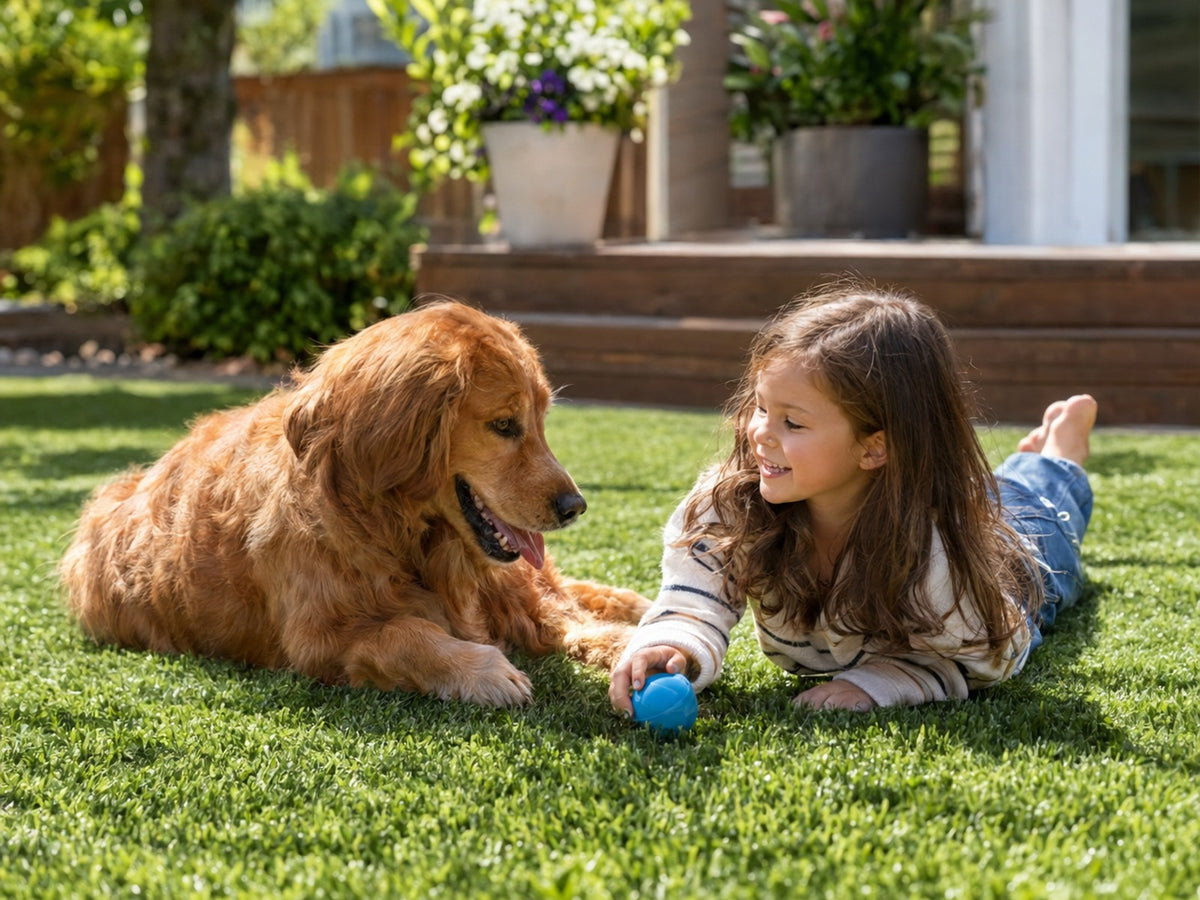
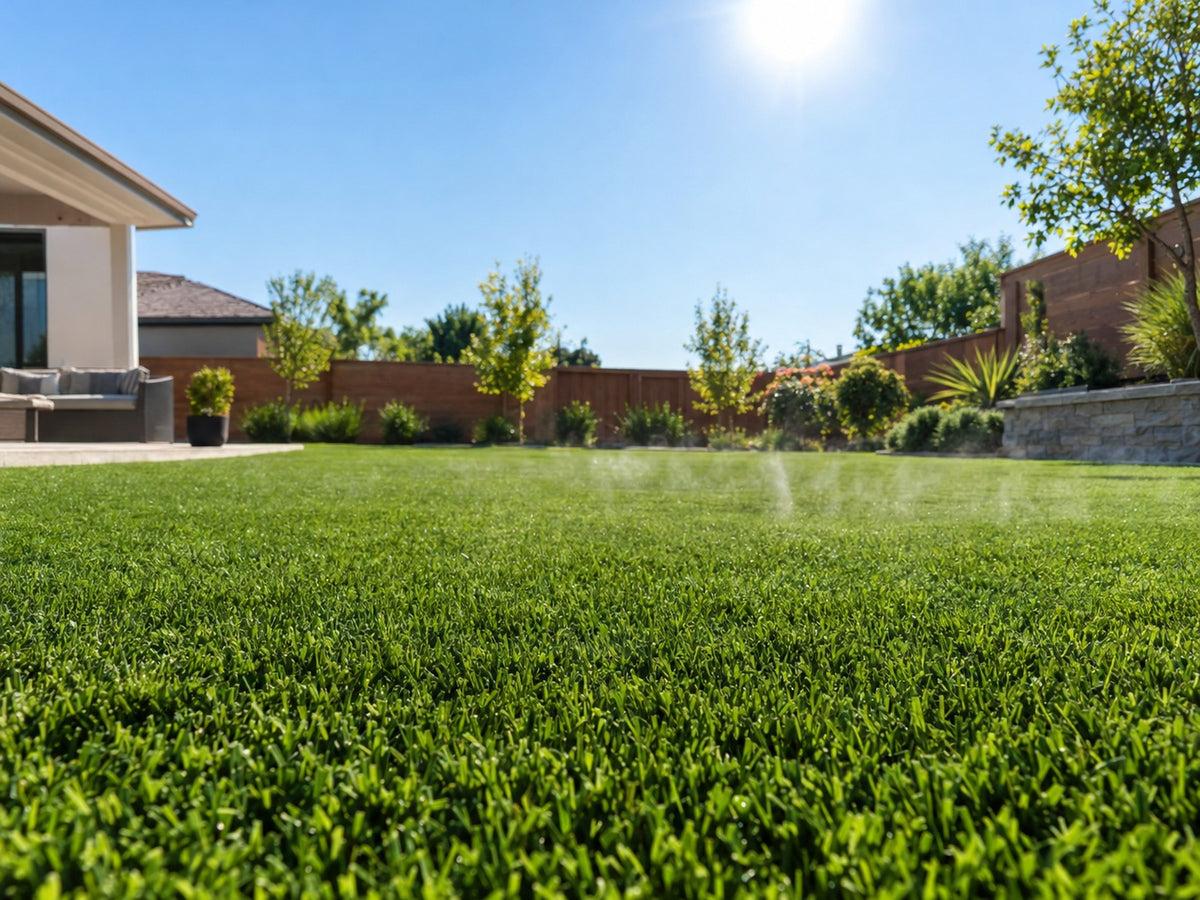
A backyard dog run gets a hose-down and a quick brush once a week. A shared artificial grass dog park gets hit by a dozen dogs before lunch, every day, with no single owner watching how it's used. Treat the two the same way and the shared space loses — matted fibers, trapped odor, and a maintenance bill nobody budgeted for. HOAs, property managers, and landscapers running a community turf area need a different plan, built for volume and built to run on a schedule, not a feeling.
Here's the maintenance plan that actually holds up under shared, high-traffic use.
Why Dog Park Turf Needs a Different Maintenance Plan Than a Backyard
A backyard lawn serves one or two dogs who use the same few square feet daily. A shared dog park serves dozens of dogs a week, each adding waste, saliva, dirt, and paw traffic to the same surface — with no single household tracking what happened on it yesterday. The math changes fast: a backyard run might see 10-15 "visits" a week, while a neighborhood dog park easily clears 100+ in the same window.
That volume compounds three problems at once. Odor builds faster because more waste hits the same square footage. Infill compacts faster because more paws and more running concentrate wear in predictable zones — gates, water stations, fence lines. And nobody's watching it happen in real time, which means small problems (a missed waste pile, a soggy infill patch) sit longer before anyone notices and fixes them.
The fix isn't a stronger spray or a tougher turf product — every SERP result for this keyword sells exactly that, and none of them answer the question a property manager actually has: what's the operational schedule once the turf is down? That's what the rest of this guide covers.
Daily Waste Removal: The Non-Negotiable First Step
Everything else on this list fails if this step slips. Solid waste left on turf for even a few hours starts breaking down into the infill and backing, and once that happens no spray or rinse fully reverses it. Daily pickup — ideally twice daily at a high-traffic park, morning and evening — is the one task that has zero downstream fix if skipped.
Set up waste stations at every entrance, not just one at the main gate. Parks that put bag dispensers and bins within sight of every entry point see dramatically better pickup compliance than parks with one station in a far corner. It's a five-minute install that saves hours of deep-cleaning later.
Walk the full turf area at each pickup, not just the obvious high-traffic strip near the gate. Dogs don't confine themselves to one zone, and a missed pile in a back corner does the same damage as one on the main path — it just takes longer to notice.
Weekly Deep-Cleaning and Deodorizing for High-Traffic Turf
Daily pickup handles solids. It does nothing for the urine that's already soaked past the fibers and into the infill — and in a shared space, that happens dozens of times a day, not once. A weekly deep-clean is where you actually address what daily pickup can't touch.
Run an enzymatic cleaner across the whole turf footprint, not just the spots that smell worst that day. Enzyme treatments break down the uric acid crystals causing odor instead of masking them, and they need real dwell time — 10 to 30 minutes, longer for set-in odor — to finish the job. Apply in the cooler part of the day; enzymes stall out fast on sun-baked turf.
Before you spray, brush. Compacted infill blocks a cleaner from reaching the backing layer where odor actually lives, so a power brush pass first opens the fibers and infill back up. For a park-sized area, our Pro Series — a 208cc Briggs & Stratton engine built for landscaper-grade, high-volume ground — covers the square footage a backyard machine can't touch in a reasonable time window. Brush first, spray second, rinse last — the same order that works on a backyard lawn, just scaled to a much bigger footprint and a much tighter schedule.
Infill Top-Offs and Compaction Checks for Shared Spaces
Infill doesn't fail all at once — it compacts gradually in the zones that take the heaviest traffic: gate entries, around water stations, and any natural "gathering spot" where dogs congregate. Those zones need checking more often than the rest of the field, because that's where turf fails first.
Build a quarterly infill check into the schedule: walk the high-traffic zones, press a hand into the surface, and compare the give against a lower-traffic section. A noticeably firmer, flatter zone means infill has compacted below the level that cushions paws and supports drainage — top it off before it becomes a bare, hard patch that's a lot more expensive to fix than a bag of infill.
Zeolite or coated-sand infill is worth the premium over plain silica in a shared dog park specifically because it resists odor absorption better under heavier, more constant waste exposure. It costs more per bag. In a space that sees this much traffic, it pays for itself in fewer deep-clean cycles.
Equipment That Scales: Sizing Up From Backyard to Commercial
The gear that works on a quarter-acre backyard doesn't scale to a shared park without turning a one-hour job into an all-day one. Matching equipment to square footage is the difference between a maintenance schedule that actually gets followed and one that quietly slips every week because it takes too long.
For a small or mid-size community park, the TurfoVolt gives a maintenance crew cordless flexibility — two G-Core 4Ah batteries, 40 minutes of runtime at 2,500 RPM — which matters when there's no reliable outlet near the turf and multiple zones to cover in one visit. For a full dog park or multi-field commercial site, step up to the Pro Series: gas-powered, built for landscapers covering serious acreage on a route, not a single backyard.
Undersized equipment is the most common reason a dog park maintenance plan collapses within a few months — not bad intentions, just a brush that takes three times longer than it should, which means the weekly deep-clean becomes the monthly deep-clean, and odor wins.
Building a Maintenance Schedule HOAs and Property Managers Can Follow
A schedule only works if whoever's responsible for it can follow it without guessing. Here's the baseline that holds up for a shared, high-traffic artificial grass dog park:
- Daily: Waste pickup across the full footprint, morning and evening at high-traffic parks. Check waste station supplies.
- Weekly: Power brush the full turf area, then apply an enzymatic deodorizer to the whole footprint — not just visible odor spots.
- Monthly: Inspect drainage points and seams for debris buildup; spot-check infill depth in high-traffic zones.
- Quarterly: Full infill top-off where compaction checks show it's needed; deeper inspection of backing and fence-line wear.
Assign ownership for each frequency, not just the task list. A schedule with no named owner for "daily" is the single most common reason dog park turf maintenance fails — everyone assumes someone else handled it. Whether that's a rotating landscaping contract, an on-site maintenance team, or an HOA volunteer, put a name and a day on the calendar, not just a task.
A shared dog park takes more abuse than any backyard setup, but the fix isn't different chemistry or a tougher turf product — it's the same core routine (pick up, brush, treat, rinse) run on a schedule sized to real traffic volume, with the right equipment to cover the ground in the time you actually have. Get the schedule right and the turf holds up. Skip a step and the whole park smells like it by the end of the month.
Browse the full GreenSweep lineup to find equipment sized for your space, or check our turf care guides for more maintenance routines built for high-traffic artificial grass.