What's the Best Glue for Artificial Turf Seams?
Artificial turf glue is the one supply on your install list that decides whether your seams vanish or your whole lawn looks patched together in six months. Buy the wrong type, skip surface prep, or rush the cure, and you'll be staring at lifted edges and a visible seam line right where two rolls meet. Get it right, and nobody can find where the seams even are.
Here's what actually matters: which adhesive to buy, how to apply it so it bonds instead of peels, and how much you actually need before you order.
One-Part vs. Two-Part Turf Glue: What's the Difference?
Every turf adhesive on the market falls into one of two categories, and picking the wrong one is the fastest way to overpay or underbuild.
One-part (1K) polyurethane adhesive comes ready to use — no mixing, no pot life to race against. It has an open time of roughly 30 minutes at 68°F, runs low on foaming, and typically ships in a resealable cartridge you can set down mid-job. This is the glue for residential backyards, small repairs, and any DIY install where you're working solo and don't need commercial-grade bond strength.
Two-part (2K) polyurethane adhesive requires mixing a base resin (Part A) with a hardener (Part B) before it goes anywhere near your turf. Open time runs 40–60 minutes at 68°F, foaming is negligible, and the bond strength is built for punishment — sports fields, putting greens, and commercial installs use 2K almost exclusively because it's independently tested to exceed FIFA's joint-strength standards (EN 12228 and EN 13744).
The decision is simple once you know your job: laying turf in a 400-square-foot backyard on a Saturday? One-part. Installing a multi-sport field or a commercial rooftop lawn that has to survive years of heavy foot traffic? Two-part, every time.
How to Glue Artificial Turf Seams the Right Way
Seam gluing is a sequence, not a single step, and skipping any part of it is how "invisible seams" become "visible seams."
- Clean the substrate. The area under the seam — base material, seam tape, or subfloor — has to be free of oil, dirt, and standing moisture. Adhesive doesn't bond to grime.
- Center your seam tape under the gap between turf edges, staked or set flat depending on your base.
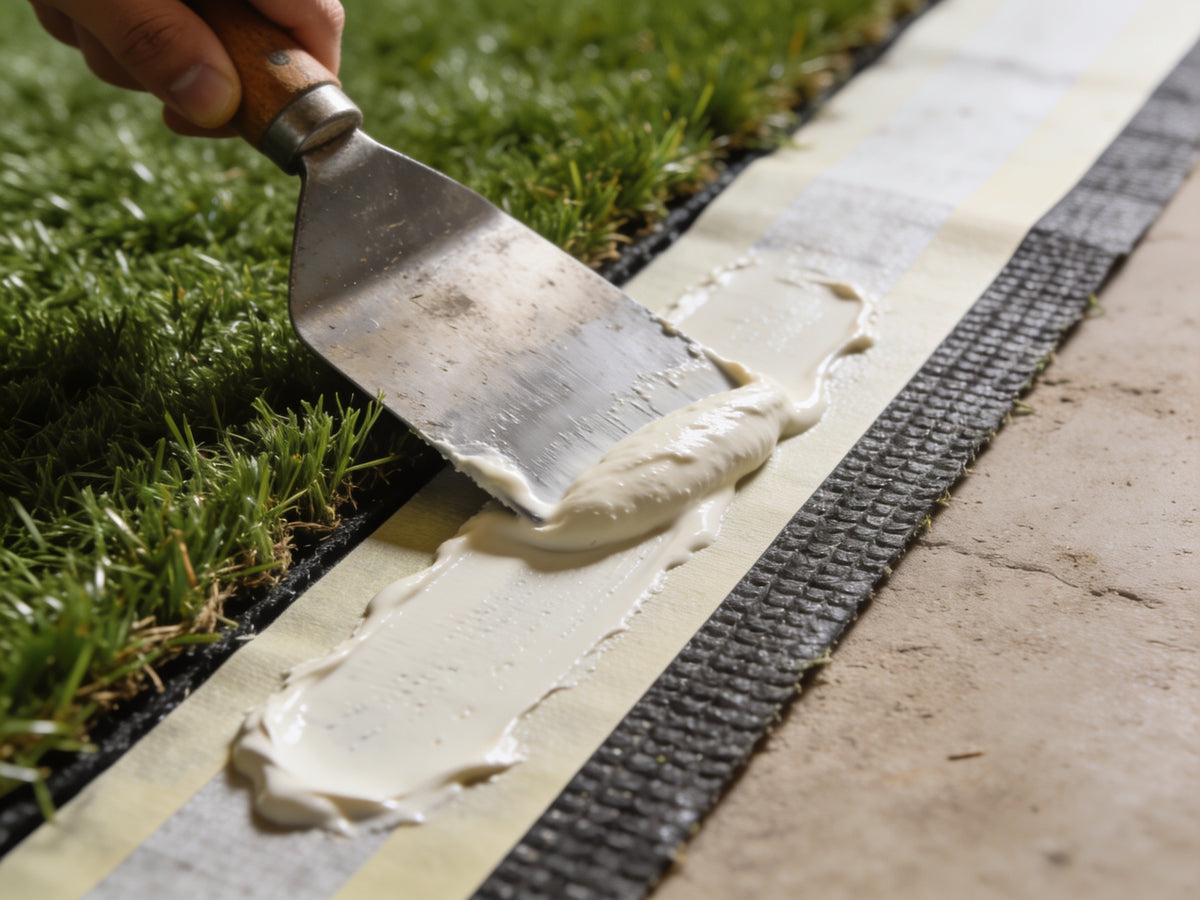
- Apply the adhesive to the tape with a trowel, caulking gun, glue box, or by pouring directly, covering the full width of the tape edge to edge.
- Wait for flash-off. Give the glue 5–7 minutes (2–3 minutes for fast-cure formulas) to absorb surface and atmospheric moisture before you lay turf over it. This step gets skipped constantly and it's why seams fail.
- Lay the turf edges down and press them together by hand, then go over the full seam with a weighted roller to force real contact between backing and adhesive.
- Wait 10–15 minutes, longer in humid conditions, then press or roll the seam a second time after 25–35 minutes of cure.
- Hold off on brooming or infilling for 2–3 hours. Full cure takes 24 hours — don't schedule a backyard party for that same afternoon.
Watch your working window: most adhesives need a surface temperature between 41°F and 95°F and ambient humidity between 20% and 80%. Below that humidity floor, cure time stretches out considerably — plan your install day around the forecast, not just your calendar.
Best Turf Glue for Concrete and Hard Surfaces
Gluing turf over a staked base and gluing it directly to concrete are two different jobs, and they call for different approaches.
Seam gluing bonds turf edges to seam tape over a compacted, staked base — this covers the vast majority of residential lawns.
Full glue-down skips the base entirely and bonds turf straight to a hard surface: concrete, pavers, or a rooftop deck with nothing to stake into. This is the method for patios, pool surrounds, and balconies.
Approved substrates for glue-down installs include concrete, cement-based patching and repair compounds, cured asphalt in good condition, and wood — but wood comes with conditions. Subfloors need double construction at a minimum 1-inch thickness, must be rigid with no flex, and need at least 18 inches of ventilated airspace underneath. Gypsum-based patching compounds are off the list entirely; they don't hold a bond.
One more substrate trap: not every adhesive works with every turf backing. Standard rubber-based carpet adhesives are built for rubber or poly-backed products — they're not formulated for the urethane or vinyl backings common on synthetic turf, and using the wrong pairing is a guaranteed seam failure down the line. Match the adhesive to the backing your turf manufacturer specifies, not whatever tub is cheapest at the hardware store.
Common Turf Glue Mistakes That Wreck a Seam
Most seam failures trace back to one of these five mistakes:
- Overusing glue. More adhesive doesn't mean a stronger bond — it means a layer too thick to cure evenly, which creates soft spots and eventual separation.
- Skipping surface prep. Oil, dirt, or trapped moisture under the seam tape breaks the bond before it ever forms.
- Rushing the cure window. Walking the seam, brooming infill, or letting foot traffic hit it before the 2–3 hour mark undoes hours of correct application.
- Wrong adhesive for the substrate. Rubber-based glue on a urethane-backed turf, or a 1K formula stretched across a commercial field that needed 2K strength — both fail under load.
- Ignoring temperature and humidity limits. Gluing outside the 41°F–95°F / 20–80% humidity window either extends cure time unpredictably or compromises the bond outright.
Every one of these is preventable with a five-minute check before you open the tube.
How Much Glue Do You Need? Coverage and Cost
Buying the right volume the first time saves you a second trip and a mismatched batch mixed mid-seam.
- A 28 oz tube covers roughly 12 linear feet of seam — fine for a single repair or a short run.
- 1 gallon of one-part adhesive covers up to 40 linear feet of seams, or 40–50 square feet for a full glue-down application.
- Two-part adhesive runs denser: budget roughly 1 gallon of mixed 2K adhesive per 20 linear feet of seam for commercial-grade coverage.
Pricing scales with format: single tubes typically run $30–50, a gallon of 1K lands in the $80–150 range, and a full 2K kit (base plus hardener) starts around $115 and climbs with volume.
The rule that keeps you from running short: measure your total linear feet of seams plus square footage of any glue-down area, then order with a 10–15% buffer. Adhesive waste from trowel drag and touch-ups is real, and running out mid-seam on a moisture-cure product is a problem you don't want.
FAQ: Cure Time, Storage, and Safety
How long does turf glue take to cure? It tacks up within minutes, holds a walkable seam by the 2–3 hour mark, and reaches full cure at 24 hours. Don't put heavy furniture or set up equipment on a fresh seam before that.
Can I store leftover glue? Yes, if you reseal the container immediately and store it between 60°F and 80°F away from humidity. Most one-part formulas cure by reacting with moisture in the air, so an improperly sealed container can set up in the tube before you use it again.
Is turf glue safe to handle? Wear gloves. Polyurethane adhesives bond to skin fast, and once cured, they can only be removed mechanically — there's no solvent that lifts it cleanly. Work in a ventilated area, especially with two-part formulas.
Can I substitute regular construction adhesive? Not recommended. Most general-purpose adhesives are rubber-based and lack the UV and weather resistance built into turf-specific formulas — they'll break down faster under sun and rain exposure than a product engineered for outdoor synthetic grass.
Bottom Line: Get the Glue Right, Get Invisible Seams
The adhesive is a small line item on an install budget, but it's the difference between a lawn that looks factory-seamless and one with a visible scar down the middle. Match the glue type to the job — one-part for residential DIY, two-part for commercial and sports turf — prep the substrate properly, respect the cure window, and buy enough on the first order.
Once those seams disappear and the turf is down for good, the real work shifts from installation to upkeep. Check the GreenSweep Guides for seasonal care routines, and browse the full product lineup — including the TurfoMax power sweeper — built to keep a freshly-glued lawn looking new for years, not just the first season.